Best bifacial solar panels 2026
Bifacial only makes sense if the rear side can actually see light. In this lineup, the strongest true bifacial picks are 630W, 590W, 540W, and 450W modules priced from $0.14/W to $0.38/W. If you want the shortest answer: buy the Longi for lowest cost per watt, the Aiko Neostar for premium rooftop specs, and the Renogy 590W if you want a consumer-friendly residential bifacial panel without moving into utility-style sourcing.
Quick picks
| Pick | Model | Why we picked it | Price |
|---|---|---|---|
| Best overall | Longi Hi-MO X10 630W (LR8-66HGD) | 22.8% efficiency, bifacial design, 25/30-year warranties, and just $0.14/W. | $0.14/W |
| Best value | Aiko Neostar 2P 540W | Premium 22.8% efficiency and 30/30-year warranty coverage at $0.28/W. | $0.28/W |
| Best for residential retrofits | 590W N-Type Bifacial Solar Panel(2-Pack) | High 590W output and 22.5% efficiency in a retail-available bifacial package. | $0.34/W |
How we picked
We ranked these panels by four things that matter at checkout: cost per watt, nameplate efficiency, warranty length, and whether the bifacial design is likely to pay back in a real installation rather than on a spec sheet. You can see our scoring methodology for the full weighting, and our affiliate disclosure explains how links are monetized.
What “good” looks like at this price
For bifacial panels in 2026, “good” starts around $0.14/W to $0.34/W in this dataset, with efficiency from 21.5% to 22.8% on the true bifacial models. That tells you the core tradeoff: the cheapest strong option here is the Longi Hi-MO X10 630W (LR8-66HGD) at $0.14/W, while retail-friendly residential options from Renogy cost more than double per watt. You are paying for channel convenience, smaller-order access, and in some cases easier procurement, not just raw silicon.
A second tradeoff is installation context. The rear-side gain that makes bifacial worthwhile depends on albedo, row spacing, tilt, and standoff. The U.S. Department of Energy notes that bifacial modules can increase energy yield, especially over bright surfaces and in ground-mount or elevated configurations, but the gain is site-specific rather than guaranteed at a fixed percentage across all installs (DOE Energy.gov). If your panels sit close to a dark roof, expect less upside than the marketing photos imply. Before you buy, size your system and run a production estimate with local irradiance tools such as PVGIS.
One more reality check: this product set includes a few excellent panels that are not bifacial, such as the Aiko Comet ABC 460W (ASM-MFH54MB) at 24.2% efficiency and the JA Solar DeepBlue 4.0 455W (JAM54D40-MB) at $0.18/W. If your roof blocks rear irradiance, a top monofacial panel can be the smarter buy.
Purchase recommendations: best bifacial solar panels 2026
If you want the best bifacial solar panels 2026 with the fewest caveats, buy bifacial only in one of three scenarios.
First, choose it for commercial or ground-mount arrays where the rear side has room to work. That is where the Longi Hi-MO X10 630W (LR8-66HGD) stands out. At 630W, 22.8% efficiency, and $0.14/W, it is the cleanest mix of output, efficiency, and price in the data.
Second, choose it for premium rooftops where you want strong front-side performance even before rear-side gain is counted. The Aiko Neostar 2P 540W fits that brief with 22.8% efficiency and 30-year product and performance warranties.
Third, choose it for residential buyers who need easier retail access. The 590W N-Type Bifacial Solar Panel(2-Pack) is expensive at $0.34/W, but it is easier to source than many commercial modules sold through installer channels. If you are still comparing against non-bifacial options, browse the full database and use our solar panel output calculator.
Value and payoff: are bifacial solar panels worth it
Yes, bifacial panels are worth it if your mounting geometry lets the rear side collect meaningful reflected light. NREL and DOE both treat bifacial gain as a system-design question, not a blanket free-power upgrade; brighter ground cover, higher mounting clearance, and wider row spacing usually improve returns (NREL).
In plain buying terms, a bifacial panel is worth the premium when the extra yield offsets the higher module or racking cost. In this lineup, that answer is easiest for the Longi because its upfront cost is already low at $0.14/W. It is harder to justify the Renogy 450W and 590W options on price alone unless retail availability or project scale matters more than strict cost per watt.
For rooftop buyers, the payoff can be modest on dark shingles with tight flush mounts. In that case, a very efficient monofacial module may beat a pricier bifacial one. If you want to model the difference, our solar payback calculator is the fastest starting point.
Efficiency performance: how efficient are bifacial solar panels
In this data set, the bifacial panels range from 21.5% to 22.8% front-side efficiency:
| Model | Bifacial | Efficiency | Wattage |
|---|---|---|---|
| Longi Hi-MO X10 630W | Yes | 22.8% | 630W |
| Aiko Neostar 2P 540W | Yes | 22.8% | 540W |
| Renogy 590W N-Type Bifacial | Yes | 22.5% | 590W |
| Renogy 450W Bifacial | Yes | 21.5% | 450W |
That front-side number is only part of the story. Bifacial modules can produce more total energy than their nameplate front efficiency suggests because the rear side adds harvest under the right conditions. IEC has standardized bifacial measurement methods, but field results still vary with site design and reflectivity, so treat any fixed “extra gain” claim cautiously unless it is tied to a modeled project layout (IEC TS 60904-1-2 overview via IEC).
Manufacturers and brands: bifacial solar panels manufacturers
Among the brands in this lineup, the actual bifacial manufacturers are Longi, Aiko, and Renogy. Longi is the strongest value play here, Aiko is the premium performance brand, and Renogy is the easiest consumer-facing option for smaller direct purchases.
Trina Solar and JA Solar are both major module manufacturers, but the specific products in this data payload are not bifacial. That matters because buyers often search by brand first and assume an entire series is dual-glass or dual-side. Check the exact model number, not just the maker name. For side-by-side filtering beyond this shortlist, use the full database.
The 7 best models
Longi Hi-MO X10 630W (LR8-66HGD)
Image not yet available.
Buy on official store → /solar-panels/longi-hi-mo-x10-lr8-66hgd-630
| Brand | Longi |
|---|---|
| Wattage | 630W |
| Efficiency | 22.8% |
| Cell type | Mono N-type |
| Bifacial | Yes |
| Product warranty | 25 years |
| Performance warranty | 30 years |
| Price | $0.14/W |
| Best use | Commercial |
The Longi is the easy top pick. It matches the best bifacial efficiency in this set at 22.8%, carries serious 25/30-year warranty coverage, and undercuts every other bifacial option on price per watt.
Pros
| Very low $0.14/W cost for a bifacial N-type panel. |
| 22.8% efficiency is tied for best among bifacial models here. |
| 25-year product and 30-year performance warranties are strong. |
Cons
| No image provided in the current data. |
| Commercial form factor may be awkward for small roofs. |
| Retail availability may be limited versus consumer brands. |
Aiko Neostar 2P 540W
Image not yet available.
Buy on official store → /solar-panels/aiko-neostar-2p
| Brand | Aiko |
|---|---|
| Wattage | 540W |
| Efficiency | 22.8% |
| Cell type | ABC |
| Bifacial | Yes |
| Product warranty | 30 years |
| Performance warranty | 30 years |
| Price | $0.28/W |
| Best use | Rooftop |
The Neostar 2P is the premium rooftop bifacial choice. It costs exactly double the Longi per watt, but you get 30/30-year warranty coverage and a rooftop-oriented format.
Pros
| 22.8% efficiency with bifacial design. |
| 30-year product warranty is best-in-class in this list. |
| Better fit for premium rooftop projects than utility-style modules. |
Cons
| $0.28/W is not a budget buy. |
| No image provided in the current data. |
| Actual rear-side gain still depends heavily on roof setup. |
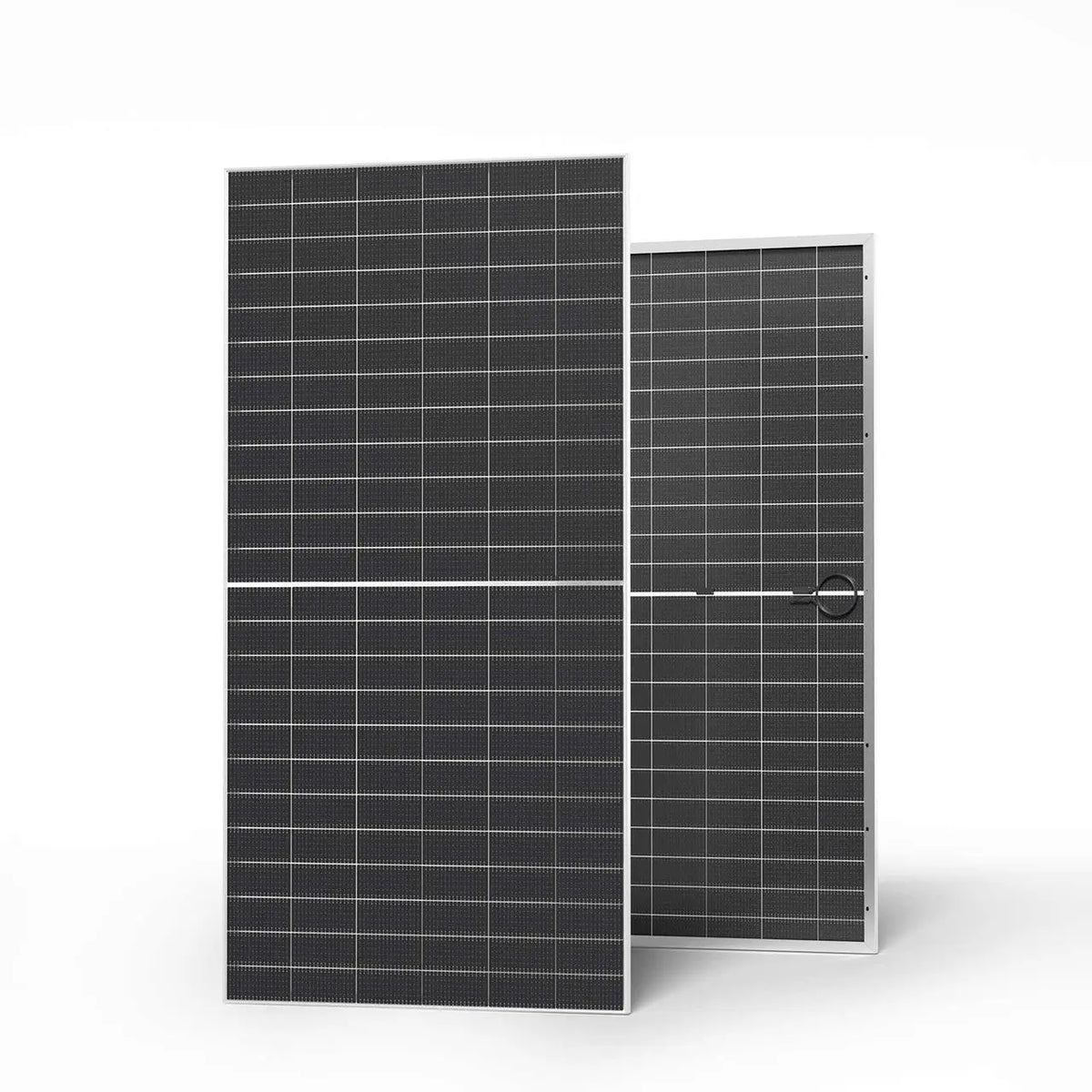
590W N-Type Bifacial Solar Panel(2-Pack)
Buy on official store → /solar-panels/renogy-bifacial-590-watt-n-type-monocrystalline-solar-panel
| Brand | Renogy |
|---|---|
| Wattage | 590W |
| Efficiency | 22.5% |
| Cell type | mono |
| Bifacial | Yes |
| Product warranty | not specified by the manufacturer |
| Performance warranty | not specified by the manufacturer |
| Price | $0.34/W |
| Best use | Residential |
This is the easiest direct-buy residential bifacial option in the list. The problem is price: $0.34/W is expensive next to commercial-channel modules.
Pros
| Strong 590W output for fewer panels per target system size. |
| 22.5% efficiency is competitive. |
| Consumer-facing availability is a real advantage. |
Cons
| Warranty terms are not specified in the provided data. |
| $0.34/W is high for this performance tier. |
| Residential installs may not unlock much rear-side gain. |
450W Bifacial Solar Panel(2-Pack)

Buy on official store → /solar-panels/renogy-bifacial-590-watt-n-type-monocrystalline-solar-panel
| Brand | Renogy |
|---|---|
| Wattage | 450W |
| Efficiency | 21.5% |
| Cell type | mono |
| Bifacial | Yes |
| Product warranty | not specified by the manufacturer |
| Performance warranty | not specified by the manufacturer |
| Price | $0.38/W |
| Best use | Residential |
This is the weakest value among the true bifacial models here. It is still viable if you need a smaller-format retail panel and cannot source installer-channel products.
Pros
| Bifacial design in a more manageable 450W size class. |
| Direct retail availability is convenient. |
| Useful for small residential arrays and custom projects. |
Cons
| $0.38/W is the highest price in the bifacial group. |
| 21.5% efficiency trails the other bifacial picks. |
| Warranty terms are not specified in the provided data. |
Trina Vertex 665W (TSM-DE21)
Image not yet available.
Buy on official store → /solar-panels/trina-vertex-tsm-de21-665
| Brand | Trina Solar |
|---|---|
| Wattage | 665W |
| Efficiency | 21.4% |
| Cell type | Mono PERC |
| Bifacial | No |
| Product warranty | 12 years |
| Performance warranty | 25 years |
| Price | $0.13/W |
| Best use | Commercial |
The Trina is here because some buyers should skip bifacial and buy the cheapest credible watt instead. At $0.13/W, it is the lowest-cost panel in the whole set, even though it is not bifacial.
Pros
| Lowest price in the lineup at $0.13/W. |
| 665W output is excellent for large arrays. |
| Strong commercial economics if rear-side gain is limited. |
Cons
| Not a bifacial panel. |
| 12-year product warranty is shorter than premium rivals. |
| 21.4% efficiency is fine, not class-leading. |
JA Solar DeepBlue 4.0 455W (JAM54D40-MB)
Image not yet available.
Buy on official store → /solar-panels/ja-solar-deepblue-4-0-jam54d40-455-mb
| Brand | JA Solar |
|---|---|
| Wattage | 455W |
| Efficiency | 22.8% |
| Cell type | Mono N-type |
| Bifacial | No |
| Product warranty | 25 years |
| Performance warranty | 30 years |
| Price | $0.18/W |
| Best use | Rooftop |
If your roof gives poor rear exposure, this JA Solar panel is one of the smartest alternatives to a bifacial module. It is efficient, well-warranted, and much cheaper than the retail bifacial options.
Pros
| 22.8% efficiency at only $0.18/W is excellent value. |
| 25/30-year warranties are strong. |
| Good rooftop choice where bifacial gain would be small. |
Cons
| Not a bifacial panel. |
| No image provided in the current data. |
| Lower wattage means more modules for large systems. |
Aiko Comet ABC 460W (ASM-MFH54MB)
Image not yet available.
Buy on official store → /solar-panels/aiko-comet-abc-460-asm-mfh54mb
| Brand | Aiko |
|---|---|
| Wattage | 460W |
| Efficiency | 24.2% |
| Cell type | ABC |
| Bifacial | No |
| Product warranty | 30 years |
| Performance warranty | 30 years |
| Price | $0.34/W |
| Best use | Rooftop |
This is the efficiency king of the list at 24.2%, but it is not bifacial. I would buy it over several bifacial panels if roof area is tight and rear-side gain is unlikely.
Pros
| 24.2% efficiency is the highest in the dataset. |
| 30/30-year warranty coverage is excellent. |
| Strong choice for space-constrained rooftops. |
Cons
| Not a bifacial panel. |
| $0.34/W is premium pricing. |
| No image provided in the current data. |
What you give up at this price
The main thing you give up with many bifacial buys is certainty. Front-side specs are easy to compare; rear-side yield is not. A 22.8% bifacial panel on a poor roof mount can underperform a cheaper monofacial panel in real-world value terms once racking, spacing, and roof reflectivity are accounted for. That is why this list includes non-bifacial alternatives like the Trina Vertex 665W (TSM-DE21) and JA Solar DeepBlue 4.0 455W (JAM54D40-MB): sometimes the better purchase is the panel that matches the site, not the trend.
You also give up some pricing efficiency if you shop through consumer retail channels. The Renogy bifacial panels are much easier for small buyers to source than many commercial modules, but they are expensive at $0.34/W to $0.38/W and the warranty details in this dataset are not specified by the manufacturer. For DIY and off-grid shoppers, that sourcing convenience can still matter more than pure economics. If your project is really a kit-based system rather than a bare-panel purchase, compare against products like the 800W 12V Complete Solar Panel Kit with 3.6kWh Battery, which is not bifacial but may better fit mobile or marine use.
Last, you often give up simplicity in design. Bifacial modules reward careful layout: more clearance, brighter surfaces, and less backside shading. If you are not ready to model that, the safest move is to compare your shortlist against a strong monofacial baseline and run the numbers before checkout.
Frequently asked questions
What size are bifacial solar panels?+
Panel size varies by wattage and format, and exact dimensions are not provided for every model in this lineup. In practice, higher-watt bifacial modules such as 590W to 665W panels are usually physically larger than 450W residential-format modules, so confirm roof, rack, and transport clearance from the manufacturer datasheet before buying.
Are bifacial solar panels bigger than standard panels?+
Not always. Some bifacial panels use large commercial form factors, but others are built in residential sizes; the bigger difference is often glass-glass construction and mounting requirements rather than simple length and width.
Do bifacial panels need a special mounting setup?+
They work best with mounting that leaves the rear side exposed to reflected light, such as elevated ground mounts, canopies, or light-colored roofs. Flush roof installs can still work, but rear-side gain is usually lower than in open-rack setups.
Can bifacial solar panels work on a roof?+
Yes, but the energy boost depends on roof color, standoff height, and how much rear-side light reaches the panel. A white membrane roof or elevated rack tends to produce more bifacial gain than a dark shingle roof with tight spacing.
How do I estimate the right panel count for my project?+
Start with your annual or daily energy use, then compare that against panel wattage, site sun hours, and system losses. Our tools to [size your system](/calculators/solar-potential) and estimate output can give you a faster first-pass answer before you choose a specific module.
Editor at SolarWorld covering portable power, balcony PV and home energy storage. Specifications quoted in this guide are pulled directly from our product database; analysis and recommendations are by Nathan Cole.
Full bio & methodology →Related articles
- Buying guide · 7 min
Best Balcony Solar Kits for Germany 800W Limit (2026): 7 Picks
Our 2026 shortlist of balcony solar kits for Germany’s 800W limit, with real specs, honest tradeoffs, and the few sets actually worth buying.
- Buying guide · 9 min
Best 60A+ Solar Charge Controllers 2026: Only 7 Picks
Need a high-current solar charge controller for a big array? Here are the best picks, honest tradeoffs, and the one 60A model worth shortlisting.
- Buying guide · 8 min
Best High-Efficiency Solar Panels 2026: 7 Worth Buying
Our 2026 shortlist of high-efficiency solar panels compares TOPCon, HJT-adjacent, and ABC picks by output, warranty, and $/W.