Best portable solar panels for power stations (2026)
Quick picks
| Pick | Model | Why it wins | Price per watt |
|---|---|---|---|
| Best overall | 200/400W N-Type Portable Solar Panel Blanket | 400W is the biggest output here, which makes it the strongest match for larger power stations. | $1.50/W |
| Best value | 250W N-Type Bifacial Solar Panel | At $0.42/W, it is easily the cheapest watt-for-watt option in this lineup. | $0.42/W |
| Best for compact grab-and-go use | E.Flex 120/220W Portable Solar Panel | 220W is a practical middle ground for faster charging without stepping up to a bulkier 400W class panel. | $1.45/W |
If you want the short version: buy 400W if your station can accept it, buy 220W if you care about easier handling, and buy the 250W bifacial if cost per watt is your main filter. Per affiliate disclosure, SolarWorld may earn from qualifying purchases.
How we picked
We ranked these panels on four things that matter for power-station buyers: usable wattage, price per watt, portability, and how likely the design is to work well in real field setups rather than lab-perfect conditions. You can see our scoring methodology for the exact framework, and compare these models against the wider full database.
What “good” looks like at this price
For portable panels paired with power stations, “good” in 2026 usually means 200W to 400W, roughly 20% to 22% stated efficiency, and a price band around $1.30/W to $1.50/W for purpose-built folding or portable formats. Below that, charging gets slow fast. At 100W, you are mostly topping off small stations or stretching runtime, not seriously refilling a larger battery in a single day. At 200W to 220W, you start getting practical daytime recovery. At 400W, you are in the range where a compatible power station can take a real chunk of energy back during strong sun.
The big tradeoff is simple: the most portable panels are not the cheapest per watt, and the cheapest per watt option here is not the most travel-friendly. That shows up clearly in this dataset. The standout value model is the 250W N-Type Bifacial Solar Panel at $0.42/W, but most buyers shopping specifically for a portable power-station panel will still prefer foldable or suitcase-style designs that are easier to carry and deploy. If you are not sure how much solar you actually need, use our tools to size your system or estimate runtime with a load calculator like /calculators/off-grid-load-calculator.
Real-world output will always be lower than the nameplate for at least part of the day because irradiance, panel temperature, angle, and cable losses all matter. NREL notes that PV output depends on solar resource and operating conditions, not just rated watts (NREL). For portable setups, that gap is often larger because people rarely maintain perfect tilt and orientation all day.
The 7 best models
Renogy 200/400W N-Type Portable Solar Panel Blanket

The 200/400W N-Type Portable Solar Panel Blanket is the clear best overall pick because 400W gives you the strongest charging ceiling in this group. If your power station accepts high solar input, this is the panel most likely to make the setup feel worthwhile rather than painfully slow.
| Spec | Value |
|---|---|
| Wattage | 400W |
| Efficiency | 21.0% |
| Cell type | Mono PERC |
| Bifacial | No |
| Price per watt | $1.50/W |
| Product warranty | not specified by the manufacturer |
| Performance warranty | not specified by the manufacturer |
Pros
| Highest wattage in this lineup at 400W. |
| 21.0% stated efficiency is solid for a portable panel. |
| Best fit for medium and large power stations. |
Cons
| $1.50/W is not cheap. |
| Warranty details are not specified by the manufacturer. |
| Large portable blankets can be awkward to reposition through the day. |
Buy on store →
Renogy 250W N-Type Bifacial Solar Panel

The 250W N-Type Bifacial Solar Panel is the value pick by a mile. At $0.42/W, nothing else here is close. If your main goal is buying the most wattage for the least money, start here.
| Spec | Value |
|---|---|
| Wattage | 250W |
| Efficiency | 22.0% |
| Cell type | mono |
| Bifacial | Yes |
| Price per watt | $0.42/W |
| Product warranty | not specified by the manufacturer |
| Performance warranty | not specified by the manufacturer |
Pros
| Lowest price per watt in the entire group. |
| Highest stated efficiency here at 22.0%. |
| Bifacial design can add rear-side gain in the right conditions. |
Cons
| Not as purpose-built for grab-and-go use as folding styles. |
| Bifacial gain is setup-dependent, not guaranteed. |
| Warranty details are not specified by the manufacturer. |
For buyers setting up on bright ground, bifacial can help, but rear-side boost varies with albedo and mounting geometry; NREL has published field work showing bifacial performance depends heavily on site conditions (NREL bifacial research).
Buy on store →
Renogy E.Flex 120/220W Portable Solar Panel

The E.Flex 120/220W Portable Solar Panel is the best balance pick. At 220W and $1.45/W, it lands in the practical center: enough output to matter, but easier to live with than a 400W blanket.
| Spec | Value |
|---|---|
| Wattage | 220W |
| Efficiency | 20.0% |
| Cell type | Mono PERC |
| Bifacial | No |
| Price per watt | $1.45/W |
| Product warranty | not specified by the manufacturer |
| Performance warranty | not specified by the manufacturer |
Pros
| 220W is a useful real-world size for many power stations. |
| Lower cost per watt than the 400W blanket. |
| More manageable than the highest-output option. |
Cons
| 20.0% efficiency trails the top models here. |
| Still not cheap at $1.45/W. |
| Warranty details are not specified by the manufacturer. |
Buy on store →
Renogy 100/200W 12V N-Type Portable Solar Panel Suitcase Kit with 20A PWM Controller

The 100/200W 12V N-Type Portable Solar Panel Suitcase Kit with 20A PWM Controller makes sense for buyers who want a structured, stand-up suitcase format. For power stations, the included PWM controller may or may not be useful depending on how your station handles solar input, so check compatibility first.
| Spec | Value |
|---|---|
| Wattage | 200W |
| Efficiency | 20.5% |
| Cell type | Mono N-type |
| Bifacial | No |
| Price per watt | $1.30/W |
| Product warranty | not specified by the manufacturer |
| Performance warranty | not specified by the manufacturer |
Pros
| Good value for a portable design at $1.30/W. |
| 20.5% efficiency is respectable. |
| 200W is a practical minimum for meaningful station charging. |
Cons
| PWM controller may be redundant for some power stations. |
| Lower output than 220W to 400W options. |
| Warranty details are not specified by the manufacturer. |
Before buying any suitcase kit for a power station, check the station’s accepted solar voltage and connector path. If you need help with matching generation to battery size, see /calculators/battery-bank-size.
Buy on store →
Renogy E.Flex 100/200W N-Type Portable Solar Panel

The E.Flex 100/200W N-Type Portable Solar Panel sits close to the suitcase kit in output, but at a higher $1.50/W. That makes it harder to recommend on pure value, though it may still appeal if you prefer this specific folding format.
| Spec | Value |
|---|---|
| Wattage | 200W |
| Efficiency | 20.0% |
| Cell type | Mono PERC |
| Bifacial | No |
| Price per watt | $1.50/W |
| Product warranty | not specified by the manufacturer |
| Performance warranty | not specified by the manufacturer |
Pros
| 200W is enough for useful daytime charging on many stations. |
| Portable form factor is easier to store than rigid panels. |
| Simple fit for buyers who want a dedicated folding panel. |
Cons
| $1.50/W is expensive for a 200W panel. |
| 20.0% efficiency is average in this field. |
| Warranty details are not specified by the manufacturer. |
Buy on store →
Renogy 100W 12V N-Type Portable Solar Panel Suitcase Kit with 20A PWM Controller

The 100W 12V N-Type Portable Solar Panel Suitcase Kit with 20A PWM Controller is the smallest “real charging” option here. For compact power stations and light-duty backup, it can work. For anything larger, it will feel slow.
| Spec | Value |
|---|---|
| Wattage | 100W |
| Efficiency | 20.5% |
| Cell type | Mono N-type |
| Bifacial | No |
| Price per watt | $1.30/W |
| Product warranty | not specified by the manufacturer |
| Performance warranty | not specified by the manufacturer |
Pros
| Lower upfront cost than larger portable panels. |
| 20.5% efficiency is decent for a 100W unit. |
| Suitcase style is easy to deploy for short sessions. |
Cons
| 100W is slow for medium and large power stations. |
| PWM controller may not add value for station users. |
| Warranty details are not specified by the manufacturer. |
Buy on store →
Renogy E.Flex 30W Portable Solar Panel
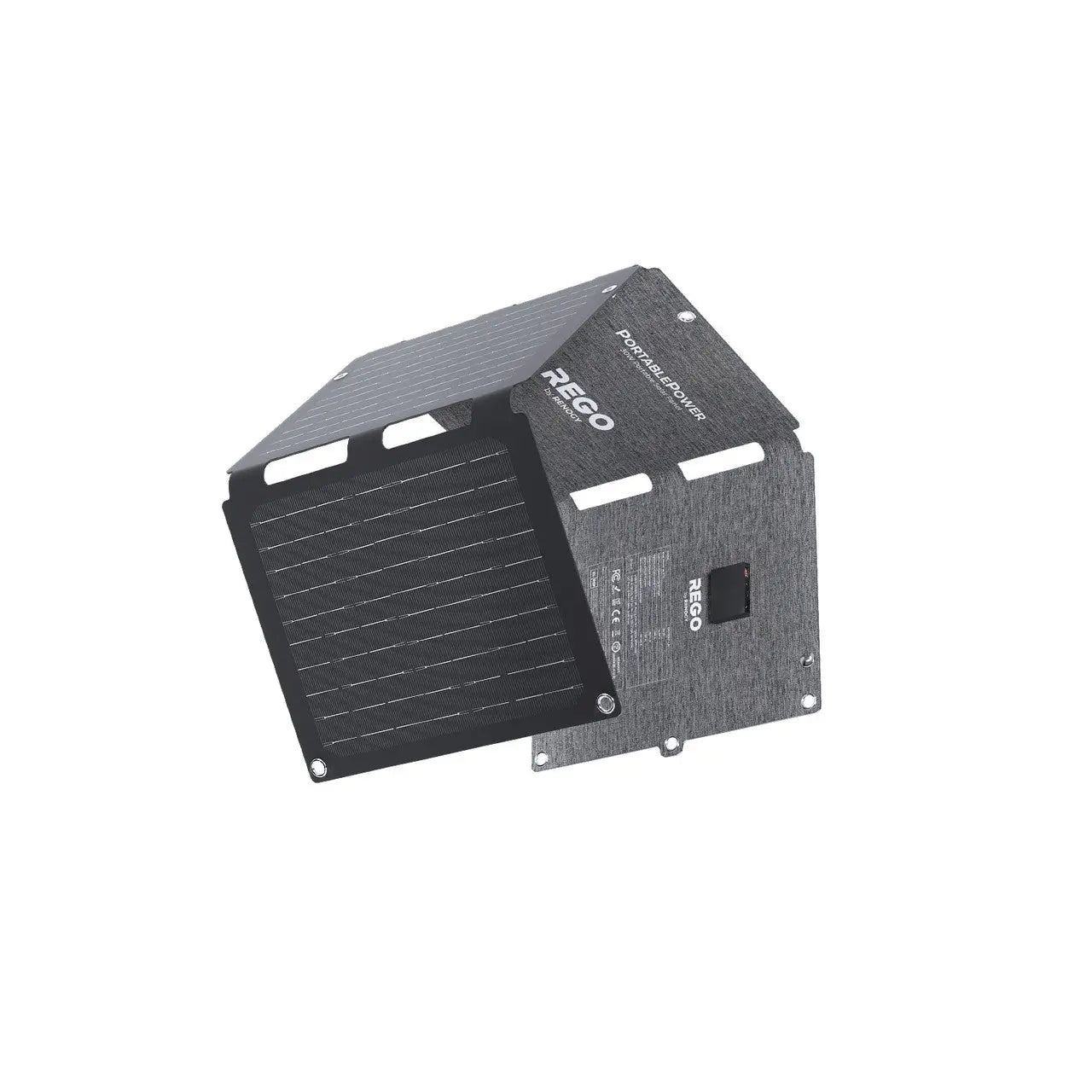
The E.Flex 30W Portable Solar Panel is not a serious match for most power stations, but it can make sense for phones, USB accessories, small battery packs, and emergency trickle charging. I would only buy it for a power station if your station is very small and your loads are tiny.
| Spec | Value |
|---|---|
| Wattage | 30W |
| Efficiency | 19.0% |
| Cell type | Mono PERC |
| Bifacial | No |
| Price per watt | $2.00/W |
| Product warranty | not specified by the manufacturer |
| Performance warranty | not specified by the manufacturer |
Pros
| Light-duty portable charging option for very small devices. |
| Easy to pack compared with larger panels. |
| Useful as a backup or maintenance charger. |
Cons
| 30W is too little for most power-station use cases. |
| Highest price per watt in this lineup at $2.00/W. |
| Lowest efficiency here at 19.0%. |
Buy on store →
What you give up at this price
The main thing you give up with portable solar panels is certainty. A power station and a panel may both look good on paper, but the charging experience depends on solar input limits, connector compatibility, cable losses, weather, and how often you actually re-aim the panel. A 400W panel can still underperform badly if your station only accepts a fraction of that input, or if you leave it flat through the middle of a hot day. If you have not checked those limits yet, do that before clicking buy.
You also give up some transparency in this specific group because warranty fields are not specified by the manufacturer in the supplied data. That does not mean the products have no warranty; it means I cannot verify the term from the dataset, so I will not invent one. The same caution applies to connector details, weight, folded dimensions, and voltage specs: those are critical for power-station matching, but they are not present here, so you should confirm them on the product page before purchase.
Finally, portable convenience costs money. The foldable and suitcase-style models cluster around $1.30/W to $1.50/W, while the cheapest watt-for-watt option in this lineup is the 250W bifacial panel at $0.42/W. If you care most about value, buy watts. If you care most about compact storage and fast setup, expect to pay more per watt. That is the core tradeoff in this category, and it is why the best buy for you may not be the one at the top of the table.
Frequently asked questions
What size portable solar panel is best for a power station?+
For most mid-size power stations, 200W to 400W is the sweet spot. It charges meaningfully faster than 100W, but is still portable enough for car camping, backup use, and short off-grid trips.
Can I use any portable solar panel with any power station?+
Not always. You need to match the panel's output voltage and connector type to the power station's solar input limits, and you should check the station's maximum input wattage before buying.
Are bifacial portable solar panels worth it for power stations?+
They can be, especially on bright surfaces like concrete, sand, or light gravel where rear-side gain is possible. In typical field use, the benefit depends heavily on setup and reflected light, so you should treat bifacial gain as a bonus rather than guaranteed output.
Is a 100W portable panel enough for a power station?+
A 100W panel works for topping up small stations, phones, lights, routers, and other light loads. It is usually too slow for larger power stations unless you have long sun hours and low daily energy use.
What matters more for portable solar panels: efficiency or price per watt?+
For power-station buyers, price per watt usually matters more first, because it determines how much panel you get for your money. Efficiency matters most when packing space is tight and you need more output from a smaller footprint.
Editor at SolarWorld covering portable power, balcony PV and home energy storage. Specifications quoted in this guide are pulled directly from our product database; analysis and recommendations are by Nathan Cole.
Full bio & methodology →Related articles
- Buying guide · 8 min
Best Portable Power Stations for Tailgating 2026: 7 Picks
The best portable power stations for tailgating and outdoor events in 2026, ranked by usable capacity, output, and price. Buy smarter fast.
- Buying guide · 8 min
Best Stackable Home Batteries 2026: Only 7 Worth Buying
Our 2026 shortlist of modular home batteries, ranked by usable kWh, power, and price—so you can buy the right stack first.
- Buying guide · 8 min
Best Balcony Solar Kits for Renters 2026: 7 Worth Buying
Our 2026 shortlist of renter-friendly plug-and-play balcony solar kits, with honest tradeoffs, prices, and the few setups actually worth your click.