🎛
Database

Solar Charge Controllers

MPPT and PWM charge controllers for DIY off-grid solar. Match panel array voltage and current to your battery bank.

21
controllers tracked
200 Watt 12 Volt Monocrystalline Solar Panel with 40 Amp MPPT Charge Controller
Renogy

200 Watt 12 Volt Monocrystalline Solar Panel with 40 Amp MPPT Charge Controller

Type
MPPT
Max A
40 A
From$469.99
36V/48V Rover Boost 10A MPPT Solar Charge Controller
Renogy

36V/48V Rover Boost 10A MPPT Solar Charge Controller

Type
MPPT
Max A
10 A
From$112.99
Adventurer Li- 30A PWM Flush Mount Charge Controller w/ LCD Display
Renogy

Adventurer Li- 30A PWM Flush Mount Charge Controller w/ LCD Display

Type
PWM
Max A
30 A
From$82.99
Battery to Charge Controller 4 AWG THHN Cables
Renogy

Battery to Charge Controller 4 AWG THHN Cables

Type
MPPT
From$54.99
Battery to Charge Controller Tray Cables for 3/8 in Lugs
Renogy

Battery to Charge Controller Tray Cables for 3/8 in Lugs

Max A
40 A
From$29.99
Data Module for Solar Charge Controllers
Renogy

Data Module for Solar Charge Controllers

Max A
10 A
From$149.99
New Edition Voyager 20A PWM Waterproof Solar Charge Controller
Renogy

New Edition Voyager 20A PWM Waterproof Solar Charge Controller

Type
PWM
Max A
20 A
From$54.99
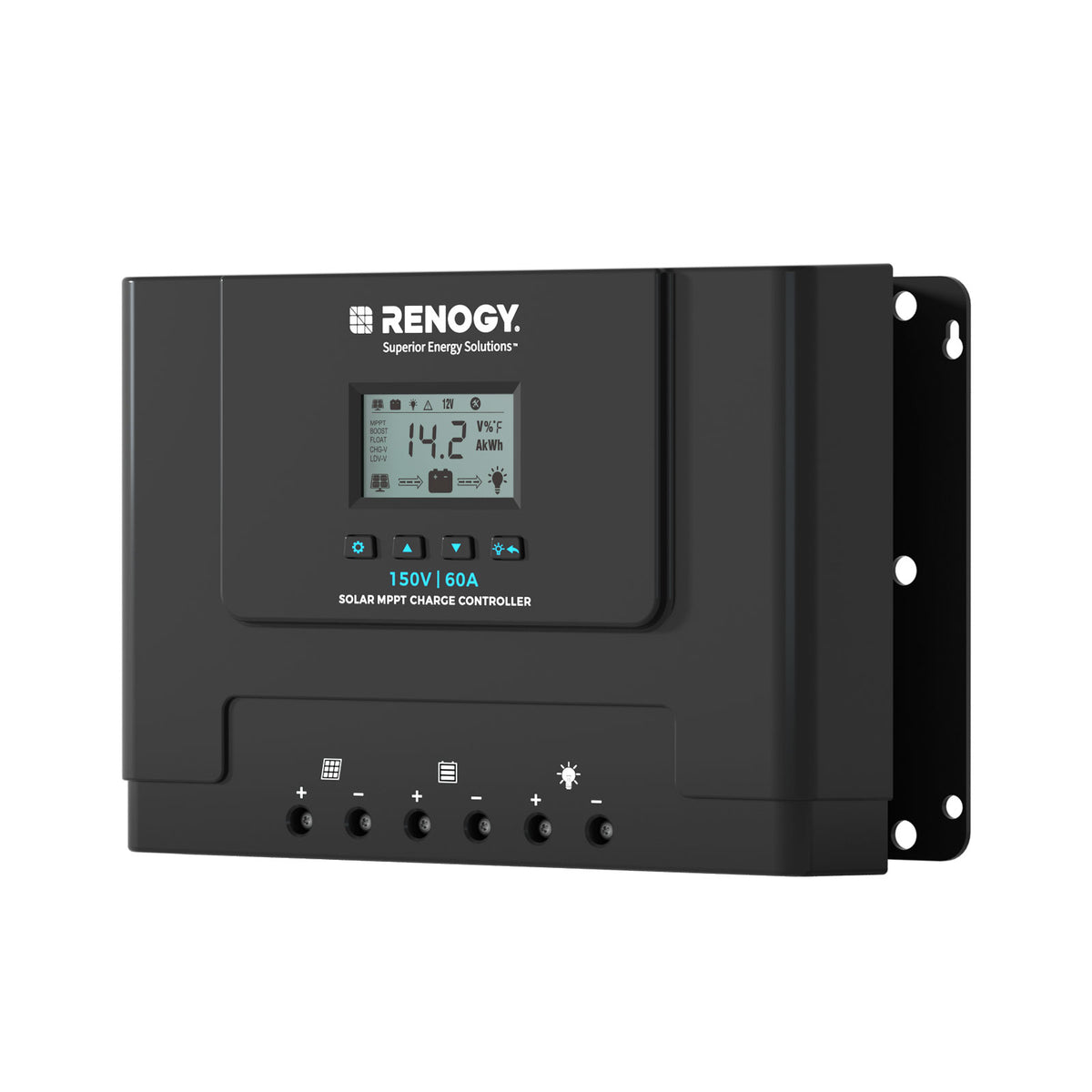
REGO 12V 60A MPPT Solar Charge Controller
Renogy

REGO 12V 60A MPPT Solar Charge Controller

Type
MPPT
Max V
100 V
Max A
60 A
From$516.99
REGO 12V/24V/36V/48V 30A MPPT Solar Charge Controller
Renogy

REGO 12V/24V/36V/48V 30A MPPT Solar Charge Controller

Type
MPPT
Max A
30 A
From$430.99
Refurbished 36V/48V Rover Boost 10A MPPT Solar Charge Controller
Renogy

Refurbished 36V/48V Rover Boost 10A MPPT Solar Charge Controller

Type
MPPT
Max A
10 A
From$52.99
Refurbished REGO 12V 60A MPPT Solar Charge Controller
Renogy

Refurbished REGO 12V 60A MPPT Solar Charge Controller

Type
MPPT
Max V
100 V
Max A
60 A
From$344.99
Rover 100 Amp MPPT Solar Charge Controller
Renogy

Rover 100 Amp MPPT Solar Charge Controller

Type
MPPT
Max A
100 A
From$701.99
Rover 60 Amp MPPT Solar Charge Controller
Renogy

Rover 60 Amp MPPT Solar Charge Controller

Type
MPPT
Max A
60 A
From$399.99
Rover Li 20 Amp MPPT Solar Charge Controller
Renogy

Rover Li 20 Amp MPPT Solar Charge Controller

Type
MPPT
Max A
20 A
From$87.99
Rover Li 20/30/40 Amp MPPT Solar Charge Controller
Renogy

Rover Li 20/30/40 Amp MPPT Solar Charge Controller

Type
MPPT
Max A
40 A
From$87.99
Rover Li 30 Amp MPPT Solar Charge Controller
Renogy

Rover Li 30 Amp MPPT Solar Charge Controller

Type
MPPT
Max A
30 A
From$149.99
Rover Lite 12V/ 24V/ 36V/ 48V 60A MPPT Solar Charge Controller
Renogy

Rover Lite 12V/ 24V/ 36V/ 48V 60A MPPT Solar Charge Controller

Type
MPPT
Max A
60 A
From$249.99
Solar Panel to Charge Controller Adaptor Kit
Renogy

Solar Panel to Charge Controller Adaptor Kit

From$43.99
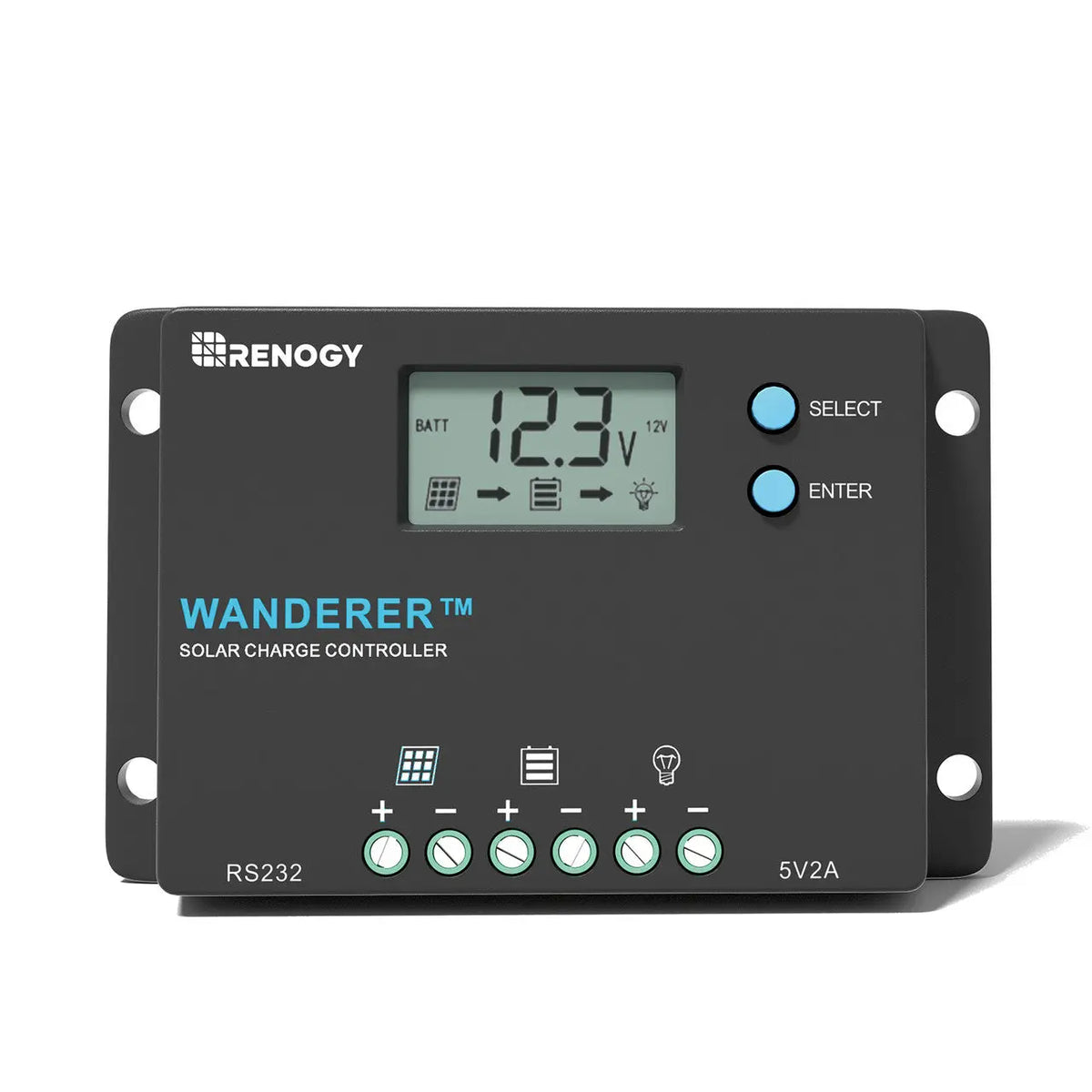
Wanderer 10A PWM Charge Controller
Renogy

Wanderer 10A PWM Charge Controller

Type
PWM
Max A
10 A
From$55.99
Wanderer 10A PWM Charge Controller with BT1
Renogy

Wanderer 10A PWM Charge Controller with BT1

Type
PWM
Max A
10 A
From$44.99
Buying guide

How to choose solar charge controllers

A solar charge controller sits between your panels and your battery bank. MPPT controllers track the panel's maximum power point continuously and can boost yield 20–30% over PWM in cold or partial-light conditions. PWM controllers are simpler and cheaper but only useful when panel voltage closely matches battery voltage.

Sizing rule: controller current rating ≥ panel array short-circuit current × 1.25, and max input voltage (Voc) must include cold-temp boost (Voc × 1.25 at −20 °C). For 12 V battery banks, a 100 V / 30 A MPPT covers up to ~400 W of array; for 48 V banks, a 150 V / 60 A covers up to ~3 kW.

What to look for

1

MPPT vs PWM

MPPT for any system above 200 W or where panel Voc differs from battery voltage. PWM only for tiny 12 V trickle systems with a matched 12 V panel.

2

Voltage headroom

Cold weather raises panel Voc by ~25%. A controller rated 100 V Voc max will trip in winter if your array sits at 90 V at STC. Always size with cold derate.

3

Battery chemistry support

LFP needs 14.2–14.6 V absorption (12 V system) and no equalisation. Lead-acid needs 14.4–14.8 V plus monthly equalisation. Cheap controllers default to lead-acid profiles and overcharge LFP — pick one with explicit LFP profile.

4

Bluetooth and monitoring

Victron, Renogy and EPEver have free apps showing daily yield, battery state, error logs. Critical for diagnosing off-grid systems remotely.

5

Wire gauge from panel to controller

Voltage drop of 2% max over the run. Use the wire gauge calculator with array short-circuit current and one-way distance to size cable correctly.

6

Number of MPPT inputs

Multiple independent MPPTs let you run separate strings (different orientations, partial shade) without yield loss. Two MPPTs is the minimum for any non-trivial DIY system.

Frequently asked

Do I need an MPPT charge controller for a 100 W panel?+

If you have a 12 V battery and a 12 V-nominal 100 W panel (~18 V), PWM is acceptable and cheap. If you have a 24 V (~36 V) panel into a 12 V battery, MPPT is mandatory — PWM would waste half the energy.

How do I size a charge controller?+

Take total array short-circuit current (Isc) × 1.25 — that's your minimum controller amp rating. Take total array open-circuit voltage (Voc) × 1.25 (cold derate) — that's your minimum max-PV voltage. Size up to the next standard model.

Can I parallel two charge controllers?+

Yes, on the battery side, with separate panel arrays per controller. Most modern controllers communicate over CAN/RS485 to coordinate. Avoid combining their outputs into one DC bus without isolation.

Why does my MPPT controller show less power than panel rating?+

Real-world output is 75–85% of STC rating due to temperature, irradiance and wiring losses. A 400 W array typically peaks at 320–340 W on a clear, cool day. If you see <60%, check shade, cable run, and panel orientation.

Victron, Renogy or EPEver?+

Victron is premium quality and has the best ecosystem (GX, Cerbo, VRM portal). Renogy is mid-tier with decent build quality and easy app. EPEver is budget — works fine for small systems but has shorter warranty and weaker support.