1
MPPT vs PWM
MPPT for any system above 200 W or where panel Voc differs from battery voltage. PWM only for tiny 12 V trickle systems with a matched 12 V panel.
MPPT and PWM charge controllers for DIY off-grid solar. Match panel array voltage and current to your battery bank.
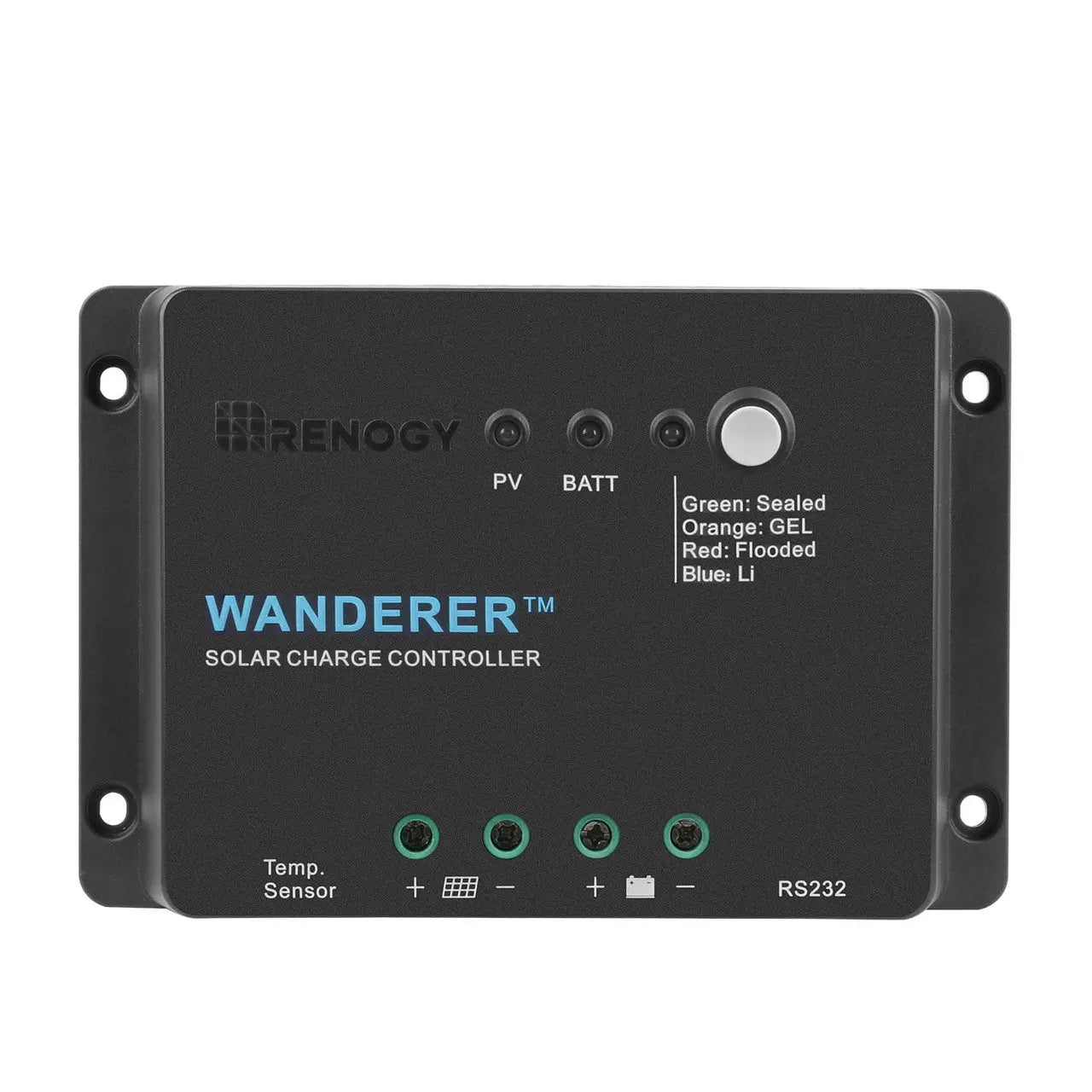
A solar charge controller sits between your panels and your battery bank. MPPT controllers track the panel's maximum power point continuously and can boost yield 20–30% over PWM in cold or partial-light conditions. PWM controllers are simpler and cheaper but only useful when panel voltage closely matches battery voltage.
Sizing rule: controller current rating ≥ panel array short-circuit current × 1.25, and max input voltage (Voc) must include cold-temp boost (Voc × 1.25 at −20 °C). For 12 V battery banks, a 100 V / 30 A MPPT covers up to ~400 W of array; for 48 V banks, a 150 V / 60 A covers up to ~3 kW.
MPPT for any system above 200 W or where panel Voc differs from battery voltage. PWM only for tiny 12 V trickle systems with a matched 12 V panel.
Cold weather raises panel Voc by ~25%. A controller rated 100 V Voc max will trip in winter if your array sits at 90 V at STC. Always size with cold derate.
LFP needs 14.2–14.6 V absorption (12 V system) and no equalisation. Lead-acid needs 14.4–14.8 V plus monthly equalisation. Cheap controllers default to lead-acid profiles and overcharge LFP — pick one with explicit LFP profile.
Victron, Renogy and EPEver have free apps showing daily yield, battery state, error logs. Critical for diagnosing off-grid systems remotely.
Voltage drop of 2% max over the run. Use the wire gauge calculator with array short-circuit current and one-way distance to size cable correctly.
Multiple independent MPPTs let you run separate strings (different orientations, partial shade) without yield loss. Two MPPTs is the minimum for any non-trivial DIY system.
If you have a 12 V battery and a 12 V-nominal 100 W panel (~18 V), PWM is acceptable and cheap. If you have a 24 V (~36 V) panel into a 12 V battery, MPPT is mandatory — PWM would waste half the energy.
Take total array short-circuit current (Isc) × 1.25 — that's your minimum controller amp rating. Take total array open-circuit voltage (Voc) × 1.25 (cold derate) — that's your minimum max-PV voltage. Size up to the next standard model.
Yes, on the battery side, with separate panel arrays per controller. Most modern controllers communicate over CAN/RS485 to coordinate. Avoid combining their outputs into one DC bus without isolation.
Real-world output is 75–85% of STC rating due to temperature, irradiance and wiring losses. A 400 W array typically peaks at 320–340 W on a clear, cool day. If you see <60%, check shade, cable run, and panel orientation.
Victron is premium quality and has the best ecosystem (GX, Cerbo, VRM portal). Renogy is mid-tier with decent build quality and easy app. EPEver is budget — works fine for small systems but has shorter warranty and weaker support.