Best 48V Solar Inverters for Off-Grid Homes (2026)
If you came here for actual 48V off-grid options, the shortlist is very short in this dataset: only one model is explicitly 48V. That matters. A 48V battery bank is the normal step up for serious off-grid loads because current falls as voltage rises; at 3,500W, a 48V bank draws roughly 73A, while a 12V bank would need about 292A before losses. That basic relationship is straight electrical math, and it is one reason larger off-grid systems often move to 48V.
So this buy list does two things. First, it names the one true 48V pick here. Second, it shows the closest alternatives for buyers who are still comparing 12V inverter/chargers, UPS-style units, and budget refurbished gear before they size your system.
Quick picks
| Pick | Model | Continuous output | Price |
|---|---|---|---|
| Best overall | Refurbished 48V 3500W Solar Inverter Charger | 3500W | $399.99 |
| Best value | Refurbished 2000W 12V Pure Sine Wave Inverter | 2000W | $219.00 |
| Best for UPS-style backup loads | 2000W 12V Pure Sine Wave Inverter with UPS Transfer Switch and Built-in Bluetooth | 2000W | $364.99 |
How we picked
We prioritized battery voltage match for off-grid use, continuous output, inverter-charger integration, price, and how clearly each model fits a real use case. We also penalized missing manufacturer specs instead of filling gaps with guesses; you can read our scoring methodology and affiliate disclosure before you click through.
What “good” looks like at this price
For this lineup, “good” starts with a hard truth: if you specifically want a 48V off-grid home inverter, the standout is the Refurbished 48V 3500W Solar Inverter Charger at $399.99. Everything else here is 12V. That does not make the 12V units bad, but it does make them a weaker fit for a full-time off-grid home once loads climb beyond the basics.
At the entry end, 1,000W to 2,000W units work for lights, routers, laptops, efficient TVs, and some kitchen loads one at a time. Around 3,000W to 3,500W is where you start getting into small-home territory, especially if the unit is an inverter charger. The catch is that missing specs matter. In this dataset, peak surge output, peak efficiency, MPPT count, and warranty are mostly not specified by the manufacturer. If you need to run a well pump, compressor, or large microwave, verify surge capacity before buying. If integrated solar charging is central to your design, confirm that separately too. For planning, NREL’s solar basics and system design resources are a better starting point than marketing copy alone (NREL).
A second tradeoff is system voltage. For the same power, higher battery voltage means lower current, which generally reduces cable size and resistive losses. That is why 48V becomes attractive for larger off-grid systems. If you are still unsure, use our size your system tool and cross-check battery runtime with a load worksheet or our broader solar calculators.
The 7 best models
Refurbished 48V 3500W Solar Inverter Charger
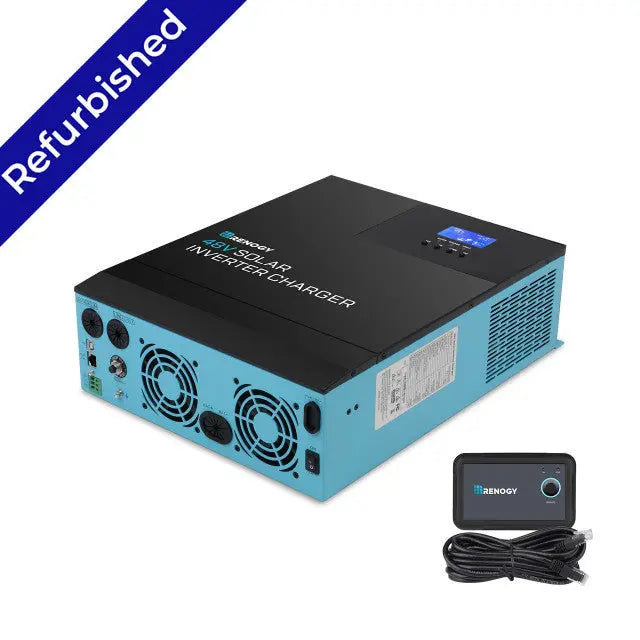
This is the obvious lead pick because it is the only explicitly 48V model in the group, and it pairs that with 3,500W continuous output for $399.99. For an off-grid cabin or modest home system, that combination is hard to ignore. The “refurbished” label is the main caveat, but the voltage match alone makes it the most relevant option on this page.
| Spec | Value |
|---|---|
| Type | Hybrid |
| Battery voltage | 48V |
| Continuous output | 3500W |
| Peak output | not specified by the manufacturer |
| MPPT count | not specified by the manufacturer |
| Grid-tied | No |
| Off-grid capable | Yes |
| Price | $399.99 |
Pros
| Pros |
|---|
| Only true 48V model in this lineup |
| 3500W is enough for many small off-grid home load stacks |
| Price is unusually low for a 48V inverter charger |
Cons
| Cons |
|---|
| Refurbished unit, not new |
| Surge output not specified by the manufacturer |
| MPPT and warranty details not specified by the manufacturer |
Refurbished 2000W 12V Pure Sine Wave Inverter

If your system is still 12V and budget is the main filter, this refurbished 2,000W unit is the best dollar-per-watt deal here at $219. It is not the right answer for a true 48V off-grid home, but it is a practical stopgap for cabins, vans, sheds, and small backup systems.
| Spec | Value |
|---|---|
| Type | Hybrid |
| Battery voltage | 12V |
| Continuous output | 2000W |
| Peak output | not specified by the manufacturer |
| Grid-tied | No |
| Off-grid capable | Yes |
| Price | $219.00 |
Pros
| Pros |
|---|
| Lowest-cost 2000W option in the group |
| Pure sine wave output |
| Good fit for smaller 12V systems |
Cons
| Cons |
|---|
| Not a 48V inverter |
| Refurbished status adds some buying risk |
| No charger or UPS function listed |
2000W 12V Pure Sine Wave Inverter with UPS Transfer Switch and Built-in Bluetooth

For users who care more about seamless backup behavior than raw expansion potential, this 2,000W UPS-style model is the cleanest niche pick. Built-in Bluetooth and a transfer switch make it easier to live with day to day than a bare inverter.
| Spec | Value |
|---|---|
| Type | Off-grid |
| Battery voltage | 12V |
| Continuous output | 2000W |
| Peak output | not specified by the manufacturer |
| Grid-tied | No |
| Off-grid capable | Yes |
| Price | $364.99 |
Pros
| Pros |
|---|
| Built-in UPS transfer switch |
| Bluetooth included |
| 2000W covers many essential circuits |
Cons
| Cons |
|---|
| Still a 12V platform |
| Costs much more than the basic 2000W inverter |
| Warranty and surge specs not specified by the manufacturer |
2000W 12V Pure Sine Wave Inverter Charger w/ LCD Display

This model earns its place because inverter-charger integration is useful in cabins and backup systems where generator charging matters. At $595.99, it is expensive for a 12V 2,000W unit, so the value case depends on whether the charger function saves you buying separate hardware.
| Spec | Value |
|---|---|
| Type | Hybrid |
| Battery voltage | 12V |
| Continuous output | 2000W |
| Peak output | not specified by the manufacturer |
| Grid-tied | No |
| Off-grid capable | Yes |
| Price | $595.99 |
Pros
| Pros |
|---|
| Integrated inverter charger |
| LCD display is useful for at-a-glance monitoring |
| Pure sine wave output |
Cons
| Cons |
|---|
| High price for a 12V 2000W unit |
| Not a 48V model |
| MPPT details not specified by the manufacturer |
2000W 12V Pure Sine Wave Inverter

The 2000W 12V Pure Sine Wave Inverter is the straightforward middle pick: no charger, no UPS language, just 2,000W of pure sine output for $285.99. If you already have charging and transfer hardware, that simplicity can be a plus.
| Spec | Value |
|---|---|
| Type | Hybrid |
| Battery voltage | 12V |
| Continuous output | 2000W |
| Peak output | not specified by the manufacturer |
| Grid-tied | No |
| Off-grid capable | Yes |
| Price | $285.99 |
Pros
| Pros |
|---|
| Lower cost than the inverter-charger version |
| Simple pure sine wave inverter format |
| Reasonable price for 2000W continuous |
Cons
| Cons |
|---|
| Not suitable for a native 48V battery bank |
| No charger function listed |
| Efficiency and warranty not specified by the manufacturer |
REGO 3000W 12V Pure Sine Wave HF Inverter Charger Split-phase Design

The REGO 3000W 12V Pure Sine Wave HF Inverter Charger Split-phase Design is the premium outlier. At $1,797.99, it is by far the most expensive model here, but it also offers 3,000W continuous and split-phase design language that may matter for specialized installs. The problem is simple: for most off-grid-home shoppers on a 48V track, the voltage mismatch and price are tough to justify.
| Spec | Value |
|---|---|
| Type | Hybrid |
| Battery voltage | 12V |
| Continuous output | 3000W |
| Peak output | not specified by the manufacturer |
| Grid-tied | No |
| Off-grid capable | Yes |
| Price | $1,797.99 |
Pros
| Pros |
|---|
| Highest-output new 12V model in this list |
| Includes inverter-charger functionality |
| Split-phase design may suit specific loads |
Cons
| Cons |
|---|
| Very expensive for a 12V platform |
| Not a 48V inverter |
| Peak and efficiency specs not specified by the manufacturer |
1000W 12V Pure Sine Wave Inverter with UPS Transfer Switch and Built-in Bluetooth

This is a small-load specialist. The 1000W 12V Pure Sine Wave Inverter with UPS Transfer Switch and Built-in Bluetooth makes sense for communications gear, lighting circuits, routers, and compact electronics where transfer-switch behavior matters more than total wattage.
| Spec | Value |
|---|---|
| Type | Off-grid |
| Battery voltage | 12V |
| Continuous output | 1000W |
| Peak output | not specified by the manufacturer |
| Grid-tied | No |
| Off-grid capable | Yes |
| Price | $269.99 |
Pros
| Pros |
|---|
| UPS transfer switch included |
| Bluetooth included |
| Compact power level suits essential electronics |
Cons
| Cons |
|---|
| 1000W is too small for most off-grid homes |
| Not a 48V model |
| Costs more than the plain 1000W inverter |
1000W 12V Pure Sine Wave Inverter

The 1000W 12V Pure Sine Wave Inverter is the cheapest new model in the set at $175.99. It is fine for very small systems, but it is not an off-grid-home main inverter unless your loads are extremely limited.
| Spec | Value |
|---|---|
| Type | Hybrid |
| Battery voltage | 12V |
| Continuous output | 1000W |
| Peak output | not specified by the manufacturer |
| Grid-tied | No |
| Off-grid capable | Yes |
| Price | $175.99 |
Pros
| Pros |
|---|
| Lowest-cost new inverter in the lineup |
| Pure sine wave output |
| Simple fit for tiny cabins and DC-heavy systems |
Cons
| Cons |
|---|
| 1000W is very limiting for home use |
| No charger or UPS feature listed |
| Not a 48V model |
For side-by-side browsing beyond these seven, check the full database. If you are comparing battery-bank architectures first, our battery bank sizing calculator and load calculator are the better next click than a checkout button.
What you give up at this price
The biggest compromise is obvious: this is not a deep bench of 48V off-grid-home inverters. It is a mixed list built around one true 48V candidate and several 12V alternatives. If your plan is a full-time off-grid house with heavier loads, long cable runs, and future expansion, most of these 12V models are stepping stones, not end-state hardware. The current penalties at 12V get real fast as power rises, which is why many larger systems standardize on 48V.
The second compromise is missing data. Peak surge output, efficiency, MPPT count, and warranty years are mostly not specified by the manufacturer in the provided dataset. That makes it harder to recommend any of these for motor loads or tightly engineered solar-charging setups without further verification. Before buying, pull the product page, installation manual, or datasheet and confirm the numbers that matter for your exact loads. If a unit will run a fridge, pump, or power tools, surge rating is not optional.
Last, the standout 48V model is refurbished. That is why its price is so compelling, but it also explains the tradeoff. If you want the cleanest fit for a 48V off-grid home from this lineup, it is still the first model I would shortlist. Just go in with open eyes, compare it against your load profile, and read our scoring methodology before treating any “best” label as universal.
Frequently asked questions
What size 48V inverter do most off-grid homes need?+
Many small off-grid cabins and backup setups land around 2,000W to 3,500W, but the right size depends on starting surges, simultaneous loads, and battery current limits. Use a load list first, then check inverter continuous output against your highest real-world demand.
Is a 48V inverter better than 12V for an off-grid home?+
For larger systems, yes. A 48V battery bank moves the same power at lower current than 12V, which usually means smaller cable losses and easier scaling. For very small systems, 12V can still be simpler and cheaper.
Can I use a 12V inverter in a 48V off-grid system?+
Not directly. The inverter input voltage has to match the battery bank voltage unless you add a properly sized DC-DC conversion stage, which adds cost and complexity.
Are refurbished solar inverter chargers worth buying?+
They can be, if the seller clearly identifies them as refurbished and the discount is large enough to justify the risk. The main tradeoff is usually support, cosmetic wear, or a shorter confidence level versus buying new.
Do these inverters include MPPT solar charge controllers?+
The provided manufacturer data does not specify MPPT count for any model here. If integrated solar charging is a must-have, verify the exact charging architecture on the product page or datasheet before you buy.
Editor at SolarWorld covering portable power, balcony PV and home energy storage. Specifications quoted in this guide are pulled directly from our product database; analysis and recommendations are by Nathan Cole.
Full bio & methodology →Related articles
- Buying guide · 7 min
Best Balcony Solar Kits for Germany 800W Limit (2026): 7 Picks
Our 2026 shortlist of balcony solar kits for Germany’s 800W limit, with real specs, honest tradeoffs, and the few sets actually worth buying.
- Buying guide · 9 min
Best Bifacial Solar Panels 2026: Only 7 Worth Buying
Our 2026 shortlist of the best bifacial solar panels, with real specs, honest tradeoffs, and the top picks by value, efficiency, and use case.
- Buying guide · 9 min
Best 60A+ Solar Charge Controllers 2026: Only 7 Picks
Need a high-current solar charge controller for a big array? Here are the best picks, honest tradeoffs, and the one 60A model worth shortlisting.