Best charge controllers for 12V battery banks (2026)
If you’re buying for a 12V battery bank, the first filter is simple: get the right charging type and enough output current. In this lineup, that means 30A is the practical floor for most small cabin, RV, and van systems, 40A is the safer middle, and 60A is the step-up pick for bigger arrays. The best buy here is the Rover Li 20/30/40 Amp MPPT Solar Charge Controller at $87.99 because it gives you MPPT, 40A output, and Bluetooth at a price that undercuts most weaker options in the same list.
We use published manufacturer specs, price, feature set, and fit-for-purpose scoring rather than marketing copy. You can read our scoring methodology and affiliate disclosure before you shop.
Quick picks
| Category | Model | Why we picked it | Price |
|---|---|---|---|
| Best overall | Rover Li 20/30/40 Amp MPPT Solar Charge Controller | 40A MPPT with Bluetooth for $87.99 is the strongest specs-per-dollar fit for most 12V banks. | $87.99 |
| Best value | Rover Li 30 Amp MPPT Solar Charge Controller | 30A MPPT at $149.99 is a clean pick for modest 12V systems that still want higher harvest than PWM. | $149.99 |
| Best for larger 12V arrays | Refurbished REGO 12V 60A MPPT Solar Charge Controller | 60A output and a specified 100V input ceiling make it the obvious step-up choice. | $344.99 |
How we picked
We prioritized controller type, output current, published input limits, monitoring features, and price, then weighted those against what actually makes sense on a 12V battery bank. MPPT models ranked higher because they can convert excess panel voltage into usable charging current more efficiently than PWM in many real installations, especially with cooler modules and longer wire runs; NREL and the U.S. Department of Energy both publish foundational PV guidance on system efficiency and component matching (NREL, DOE). For the full rubric, see our scoring methodology.
What “good” looks like at this price
For a 12V battery bank, “good” in 2026 means MPPT if your budget allows, at least 30A output for anything beyond a tiny setup, and Bluetooth if the controller will be mounted out of sight. In this dataset, the strongest values are clustered between $82.99 and $149.99, with one standout at $87.99 that makes several pricier options hard to justify. If you need help matching controller size to panel wattage, use our tool to size your system.
The biggest tradeoff is that the provided manufacturer data is incomplete on several fields that matter in real installs. For most models here, maximum PV input voltage is not specified by the manufacturer in the supplied data, and battery chemistry support is also not specified by the manufacturer. That means you can compare current rating and price cleanly, but you should still verify the exact battery profile support and PV string limits on the product page before checkout. If you want to browse beyond this shortlist, the full database is the better place to filter.
A second tradeoff: one item in the payload is not a controller at all. The Battery to Charge Controller Tray Cables for 3/8 in Lugs are useful accessories, but they are not a substitute for a charge controller. I included them below only because they were supplied in the dataset and are relevant to installation.
MPPT or PWM for a 12V battery bank?
If your panels are truly “12V nominal” and the system is small, PWM can still be the cheapest workable answer. That’s why the Adventurer Li- 30A PWM Flush Mount Charge Controller w/ LCD Display remains relevant at $82.99. You get a 30A controller for less money than many MPPT units, and flush-mount packaging can be handy in RV walls or cabinet faces.
But the value tilt in this lineup clearly favors MPPT. The Rover Li 20/30/40 Amp MPPT Solar Charge Controller is 40A, MPPT, Bluetooth-enabled, and only $87.99 in the supplied data. At that price spread, PWM is no longer the automatic budget winner. If your array voltage is above battery voltage by a useful margin, MPPT is the better fit.
How many amps do you actually need for a 12V bank?
For a 12V system, controller amperage is the number that most directly limits future expansion. A 30A controller is fine for many modest builds. A 40A controller gives more breathing room. A 60A controller is where larger 12V banks start to make sense without immediate replacement.
As a rough planning rule, array watts divided by charging voltage gives you expected current, then you leave margin for real-world conditions. Since charging voltage on a 12V bank is above 12.0V in normal charging, many buyers use calculators rather than mental math; see solar calculator tools and battery bank sizing help. In this list, 10A is too small for most full-time 12V house banks, while 30A to 40A is the mainstream sweet spot.
The 7 best models
1) Rover Li 20/30/40 Amp MPPT Solar Charge Controller

Why it made the list: At $87.99, this is the easiest recommendation in the group. You get MPPT, 40A output, and Bluetooth. For a 12V battery bank, that is enough current for a lot of real-world RV, van, and shed systems while leaving some room to grow.
| Spec | Value |
|---|---|
| Type | MPPT |
| Max input current | 40A |
| Max input voltage | not specified by the manufacturer |
| Bluetooth | Yes |
| App support | No |
| Price | $87.99 |
Pros - 40A output is strong for a mainstream 12V build - MPPT at this price is unusually competitive - Bluetooth helps if the controller is mounted remotely
Cons - Input voltage limit is not specified in the supplied data - Battery chemistry support is not specified by the manufacturer - Product name bundles 20/30/40A variants, which can confuse buyers
2) Rover Li 30 Amp MPPT Solar Charge Controller

The Rover Li 30 Amp MPPT Solar Charge Controller is the cleaner pick if you know 30A is enough and want a dedicated model rather than a multi-variant product page. It costs $149.99, which is harder to defend against the cheaper 40A Rover, but it is still a solid 12V-bank controller on paper.
| Spec | Value |
|---|---|
| Type | MPPT |
| Max input current | 30A |
| Max input voltage | not specified by the manufacturer |
| Bluetooth | Yes |
| App support | No |
| Price | $149.99 |
Pros - MPPT is the right charging type for many 12V arrays - 30A fits smaller battery banks well - Bluetooth included
Cons - More expensive than the 40A Rover in this dataset - Input voltage limit is not specified - App support is listed as No
3) Refurbished REGO 12V 60A MPPT Solar Charge Controller

The Refurbished REGO 12V 60A MPPT Solar Charge Controller is the only model here with a clearly stated 100V max input voltage in the supplied data, and its 60A output makes it the best option for larger 12V banks. At $344.99, it is not cheap, but it is the most capable controller in the list.
| Spec | Value |
|---|---|
| Type | MPPT |
| Max input current | 60A |
| Max input voltage | 100V |
| Bluetooth | Yes |
| App support | No |
| Price | $344.99 |
Pros - Highest output current in the lineup at 60A - 100V input ceiling is actually specified - Better fit for expansion than 30A units
Cons - Refurbished status will deter some buyers - Much pricier than the 30A and 40A options - Battery chemistry support is not specified
4) Adventurer Li- 30A PWM Flush Mount Charge Controller w/ LCD Display

The Adventurer Li- 30A PWM Flush Mount Charge Controller w/ LCD Display is the best PWM option here if flush mounting matters. It’s 30A, costs $82.99, and includes Bluetooth in the supplied data, though app support is listed as No.
| Spec | Value |
|---|---|
| Type | PWM |
| Max input current | 30A |
| Max input voltage | not specified by the manufacturer |
| Bluetooth | Yes |
| App support | No |
| Price | $82.99 |
Pros - Lower cost than many MPPT controllers - Flush-mount format suits RV interiors - 30A is enough for many small systems
Cons - PWM leaves harvest on the table versus MPPT in many setups - Input voltage limit is not specified - Nearly the same price as a 40A MPPT alternative here
5) Wanderer Li 30A PWM Charge Controller
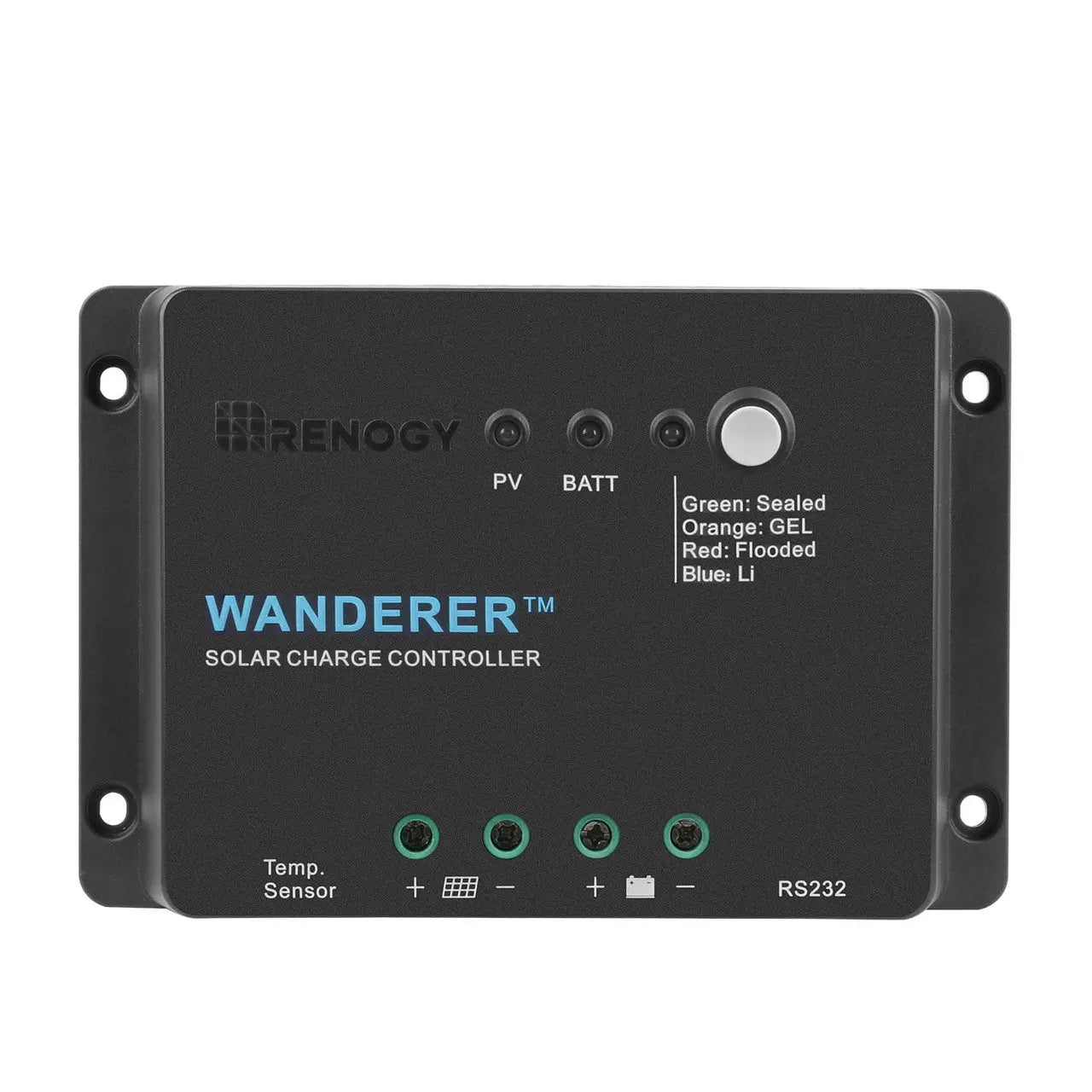
The Wanderer Li 30A PWM Charge Controller is the cheapest controller in the set at $32.99, which is why it makes the list despite a data oddity: the supplied payload labels its type as MPPT, while the product name says PWM. I’m trusting the product name here and treating it as a PWM model, but that mismatch is exactly the kind of thing you should verify before buying.
| Spec | Value |
|---|---|
| Type | PWM in product name; supplied type field says MPPT |
| Max input current | 30A |
| Max input voltage | not specified by the manufacturer |
| Bluetooth | Yes |
| App support | No |
| Price | $32.99 |
Pros - Lowest price in the lineup by a wide margin - 30A rating is useful for basic 12V systems - Bluetooth is unusual at this price
Cons - Type data is inconsistent in the supplied specs - Input voltage limit is not specified - Budget PWM units are less flexible than MPPT
6) 200 Watt 12 Volt Monocrystalline Solar Panel with 40 Amp MPPT Charge Controller

The 200 Watt 12 Volt Monocrystalline Solar Panel with 40 Amp MPPT Charge Controller is not just a controller; it’s a bundled kit priced at $469.99. If you need both panel and controller, the package can reduce shopping friction. If you only need a controller, it is not the efficient buy.
| Spec | Value |
|---|---|
| Type | MPPT |
| Max input current | 40A |
| Max input voltage | not specified by the manufacturer |
| Bluetooth | No |
| App support | No |
| Price | $469.99 |
Pros - Includes a 200W panel and 40A MPPT controller - Simplifies first-time system purchasing - 40A output leaves room beyond the included panel
Cons - Expensive if you only need the controller - Input voltage limit is not specified - No Bluetooth in the supplied data
7) Refurbished 36V/48V Rover Boost 10A MPPT Solar Charge Controller

The Refurbished 36V/48V Rover Boost 10A MPPT Solar Charge Controller is the weakest match for the topic because it is explicitly a 36V/48V boost controller and only 10A. At $52.99, it’s affordable, but it is not a normal recommendation for a 12V battery bank shopping list. I’m including it because it was in the supplied product data, not because it’s a strong fit.
| Spec | Value |
|---|---|
| Type | MPPT |
| Max input current | 10A |
| Max input voltage | not specified by the manufacturer |
| Bluetooth | Yes |
| App support | No |
| Price | $52.99 |
Pros - MPPT design - Low price for a specialty controller - Bluetooth included
Cons - Not intended for standard 12V battery-bank use - 10A is too small for most house-bank charging - Refurbished status narrows appeal
What you give up at this price
The big compromise in this lineup is spec transparency. Only one controller here, the REGO 60A, includes a stated 100V max input voltage in the supplied data. For the rest, that key number is missing. On a real solar install, PV input ceiling is not a minor detail; it determines how you wire your array and whether a cold-weather voltage spike could push you out of spec. If you’re comparing these models before purchase, click through and verify the manufacturer page before locking in your panel string design.
You also give up some confidence on battery compatibility details. Several products carry “Li” branding, but the provided data does not specify battery chemistry support. That matters if you’re charging LiFePO4, AGM, flooded lead-acid, or gel and expect configurable charge profiles. In budget controllers, the difference between “works” and “works correctly” is often buried in the charging menu and manual, not the headline spec.
Finally, the value spread in this dataset is uneven. The cheapest option is very cheap, but it comes with data ambiguity. The best mainstream pick is almost suspiciously inexpensive for a 40A MPPT model. And one product is really a kit, while another is really an accessory: Battery to Charge Controller Tray Cables for 3/8 in Lugs are useful once you’ve chosen a controller, but they should not be mistaken for one. That’s the short version of this list: there are a few strong buys, a few edge cases, and a lot of reasons to verify the exact product page before you click.
Frequently asked questions
Is MPPT worth paying for on a 12V battery bank?+
Usually yes if you have room for higher-voltage panels, expect cold-weather charging, or want better harvest from the same array. PWM still makes sense for very small, low-cost 12V systems where panel voltage is closely matched to battery voltage.
How many amps of charge controller do I need for a 12V system?+
Start with your array wattage divided by battery charging voltage, then add safety margin. For example, 400W into a 12V bank can land in the 25A to 35A range depending on operating voltage, so many buyers step up to a 30A or 40A controller.
Can I use a 30A controller with lithium and lead-acid batteries?+
That depends on the controller's supported battery profiles and settings. In this lineup, several units are marketed as 'Li' models, but battery chemistry support details are not fully specified in the provided manufacturer data, so check the product page before buying.
Are refurbished charge controllers worth it?+
They can be if the discount is meaningful and the seller stands behind the product. For larger 12V arrays, a refurbished 60A MPPT unit can offer a lot more headroom per dollar than buying new.
Do I need Bluetooth on a charge controller?+
No, but it is useful for checking charging current, battery status, and settings without opening a compartment. If your controller is mounted in a trailer cabinet, van electrical bay, or shed, Bluetooth is more than a convenience.
Editor at SolarWorld covering portable power, balcony PV and home energy storage. Specifications quoted in this guide are pulled directly from our product database; analysis and recommendations are by Nathan Cole.
Full bio & methodology →Related articles
- Buying guide · 8 min
Best BLUETTI Portable Power Stations 2026: 7 Worth Buying
Our 2026 short list of the best BLUETTI power stations, with exact specs, honest tradeoffs, and the few models actually worth your money.
- Buying guide · 8 min
Best Jackery Power Stations 2026: Only 7 Worth Buying
Our 2026 shortlist of the best Jackery portable power stations, with clear tradeoffs, real specs, and quick picks to help you buy fast.
- Buying guide · 9 min
Best Emergency Power Stations 2026: Only 7 Worth Buying
Our 2026 shortlist of portable power stations for outages, with honest tradeoffs, exact specs, and the best picks by budget and backup need.