Best MPPT Solar Charge Controllers Under $200 (2026)
If your budget caps at $200, the short version is simple: buy a real MPPT model, not a cheap PWM unit mislabeled as one. In this lineup, the strongest picks are the 40A and 30A Renogy Rover Li units, plus the 10A Rover Boost if you run a 36V or 48V battery bank. A few PWM and accessory products appear in the same price band, and I’ve called those out clearly so you don’t click the wrong thing.
Quick picks
| Category | Model | Why it wins | Price |
|---|---|---|---|
| Best overall | Rover Li 20/30/40 Amp MPPT Solar Charge Controller | 40A output for $87.99 is the biggest usable MPPT headroom here. | $87.99 |
| Best value | Rover Li 20 Amp MPPT Solar Charge Controller | Real MPPT at $87.99 without paying for current capacity many small systems do not need. | $87.99 |
| Best for 48V systems | 36V/48V Rover Boost 10A MPPT Solar Charge Controller | One of the few listed models aimed specifically at 36V/48V battery banks. | $112.99 |
How we picked
We prioritized actual MPPT units under $200, then sorted for usable charge current, battery-voltage fit, price, and whether the listing clearly identified the product as MPPT rather than PWM. We also flagged bad-fit products that show up in this price range so you can avoid false bargains. You can read our scoring methodology and our full affiliate disclosure before you buy.
What “good” looks like at this price
A good sub-$200 MPPT controller should do three things: first, be explicitly listed as MPPT; second, offer enough output current for your battery bank; third, fit your system voltage without forcing odd panel wiring. In plain terms, 20A to 40A is the useful range for most small cabin, van, RV, and backup setups in this bracket. If you need help matching array size to controller current, size your system before picking by price alone.
The main tradeoff at this price is missing spec depth. In this dataset, maximum PV input voltage, supported battery chemistries, and app support are often not specified by the manufacturer. That matters, because controller sizing depends on panel Voc in cold weather; the U.S. Department of Energy notes that solar module output conditions vary with environment, and cold temperatures can push voltage upward relative to nominal conditions (DOE). If a listing does not state input voltage limits, treat that as a yellow flag and verify the datasheet before checkout.
One more reality check: not every cheap “solar charge controller” under $200 is MPPT. In the product pool here, several are PWM units, and one is a cable set. I included them in the ranked list only because they were provided in the source data and are easy to confuse with the MPPT options while shopping. For a broader view beyond this shortlist, see the full database or compare with our other solar calculators.
Which MPPT controller should most people buy?
For most buyers, the Rover Li 20/30/40 Amp MPPT Solar Charge Controller is the easy pick because it gives you up to 40A output at just $87.99. On price-per-amp alone, that is the strongest deal in the lineup. If your system may grow, the extra current headroom is worth more than shaving a few dollars off the upfront cost.
If your array is modest and you know you do not need 30A or 40A, the Rover Li 20 Amp MPPT Solar Charge Controller is the cleaner buy. Same listed price, less capacity, but still a real MPPT option that makes sense for smaller 12V setups.
For 36V or 48V battery systems, the Rover Li 30 Amp MPPT Solar Charge Controller is not necessarily the best fit just because it has more amps. The dedicated 36V/48V Rover Boost models are more targeted. If your battery bank voltage is the deciding factor, pick around that first and current second.
Are cheap MPPT controllers better than PWM?
Usually yes, but only if they are actually MPPT. MPPT controllers can convert higher panel voltage down to battery voltage more efficiently than PWM controllers, which is why they are generally the better match for larger panels, colder climates, and longer wire runs. NREL’s PV research consistently treats maximum power point tracking as a core part of efficient PV power conversion in modern systems (NREL).
The problem in the bargain tier is misclassification. In this product set, the Wanderer and Adventurer PWM models cost less, but they are not direct substitutes for a true MPPT controller if your system depends on higher-voltage panel operation. A cheap PWM controller can be a rational buy for a tiny, tightly matched 12V setup. It is not the right answer if you are trying to squeeze the most out of a larger module or a higher-voltage array.
The 7 best models
1) Renogy Rover Li 20/30/40 Amp MPPT Solar Charge Controller

Buy on Renogy →
This is the best buy in the list because it combines true MPPT labeling, 40A maximum input current, Bluetooth support, and an $87.99 price. For small off-grid systems, that is enough current to cover a meaningful 12V or 24V setup without pushing into the next pricing tier.
The catch is missing published detail in the provided data. Maximum PV input voltage and supported battery chemistry are not specified by the manufacturer here, and app support is also not specified. I would still rank it first because the current capacity-to-price ratio is unusually strong.
| Key spec | Value |
|---|---|
| Type | MPPT |
| Max input current | 40A |
| Bluetooth | Yes |
| App support | Not specified by the manufacturer |
| Price | $87.99 |
Pros - 40A capacity at under $90 - Bluetooth is included - Best expansion headroom in this list
Cons - Max input voltage not specified by the manufacturer - Battery chemistry support not specified by the manufacturer - Product naming is confusing across 20/30/40A variants
2) Renogy Rover Li 30 Amp MPPT Solar Charge Controller

Buy on Renogy →
At $149.99, this is the straightforward mid-capacity pick if you want a dedicated 30A MPPT controller and do not need the full 40A headroom of the larger Rover Li family listing. It is still below the $200 ceiling, and 30A is a practical size for many RV and cabin systems.
The issue is value. In this dataset, the 40A Rover listing is cheaper, so this 30A model is harder to justify unless you specifically want this exact unit or the seller page has better stock and warranty terms.
| Key spec | Value |
|---|---|
| Type | MPPT |
| Max input current | 30A |
| Bluetooth | Yes |
| App support | Not specified by the manufacturer |
| Price | $149.99 |
Pros - True MPPT under $200 - 30A is enough for many small systems - Bluetooth is included
Cons - Worse value than the cheaper 40A Rover listing - Max input voltage not specified by the manufacturer - Battery chemistry support not specified by the manufacturer
3) Renogy Rover Li 20 Amp MPPT Solar Charge Controller

Buy on Renogy →
The Rover Li 20 Amp MPPT Solar Charge Controller is the right fit for buyers who know their system is small and stable. At $87.99, it gives you MPPT performance without overspending on current capacity you may never use.
Its weakness is obvious: the 40A sibling is listed at the same price in this source data. If both are genuinely available at those prices, the 20A version is only the better buy if you are optimizing around compactness, stock availability, or a known low-current design.
| Key spec | Value |
|---|---|
| Type | MPPT |
| Max input current | 20A |
| Bluetooth | Yes |
| App support | Not specified by the manufacturer |
| Price | $87.99 |
Pros - Real MPPT at a low price - Good fit for smaller arrays - Bluetooth is included
Cons - Same listed price as the higher-capacity 40A model - Max input voltage not specified by the manufacturer - Battery chemistry support not specified by the manufacturer
4) Renogy 36V/48V Rover Boost 10A MPPT Solar Charge Controller

Buy on Renogy →
This is the niche pick. At $112.99, the 36V/48V Rover Boost 10A MPPT controller is one of the only models in the data clearly aimed at 36V and 48V battery systems. If that is your bank voltage, that specificity matters more than raw amp count.
Ten amps is the limiting factor. This is not a growth-friendly controller, and it will be too small for many users unless the array is modest. Still, for a compact higher-voltage setup, it is a cleaner fit than trying to force a generic 12V/24V-oriented controller into the job.
| Key spec | Value |
|---|---|
| Type | MPPT |
| Max input current | 10A |
| Bluetooth | Yes |
| App support | Not specified by the manufacturer |
| Price | $112.99 |
Pros - Specifically for 36V/48V systems - True MPPT - Bluetooth is included
Cons - Only 10A - Max input voltage not specified by the manufacturer - Expensive for the current capacity
5) Renogy Refurbished 36V/48V Rover Boost 10A MPPT Solar Charge Controller

Buy on Renogy →
The Refurbished 36V/48V Rover Boost 10A MPPT Solar Charge Controller costs $52.99, less than half the price of the new version. If you need a 36V or 48V MPPT controller and your system is small, this is the best bargain in the whole list.
The tradeoff is refurbished inventory. Stock may be inconsistent, and buyers should verify warranty terms on the product page before ordering. Still, for a known-fit high-voltage battery bank, this is one of the few genuinely compelling low-cost options.
| Key spec | Value |
|---|---|
| Type | MPPT |
| Max input current | 10A |
| Bluetooth | Yes |
| App support | Not specified by the manufacturer |
| Price | $52.99 |
Pros - Lowest-priced true MPPT option here - Specifically aimed at 36V/48V systems - Bluetooth is included
Cons - Refurbished stock can disappear fast - Only 10A - Max input voltage not specified by the manufacturer
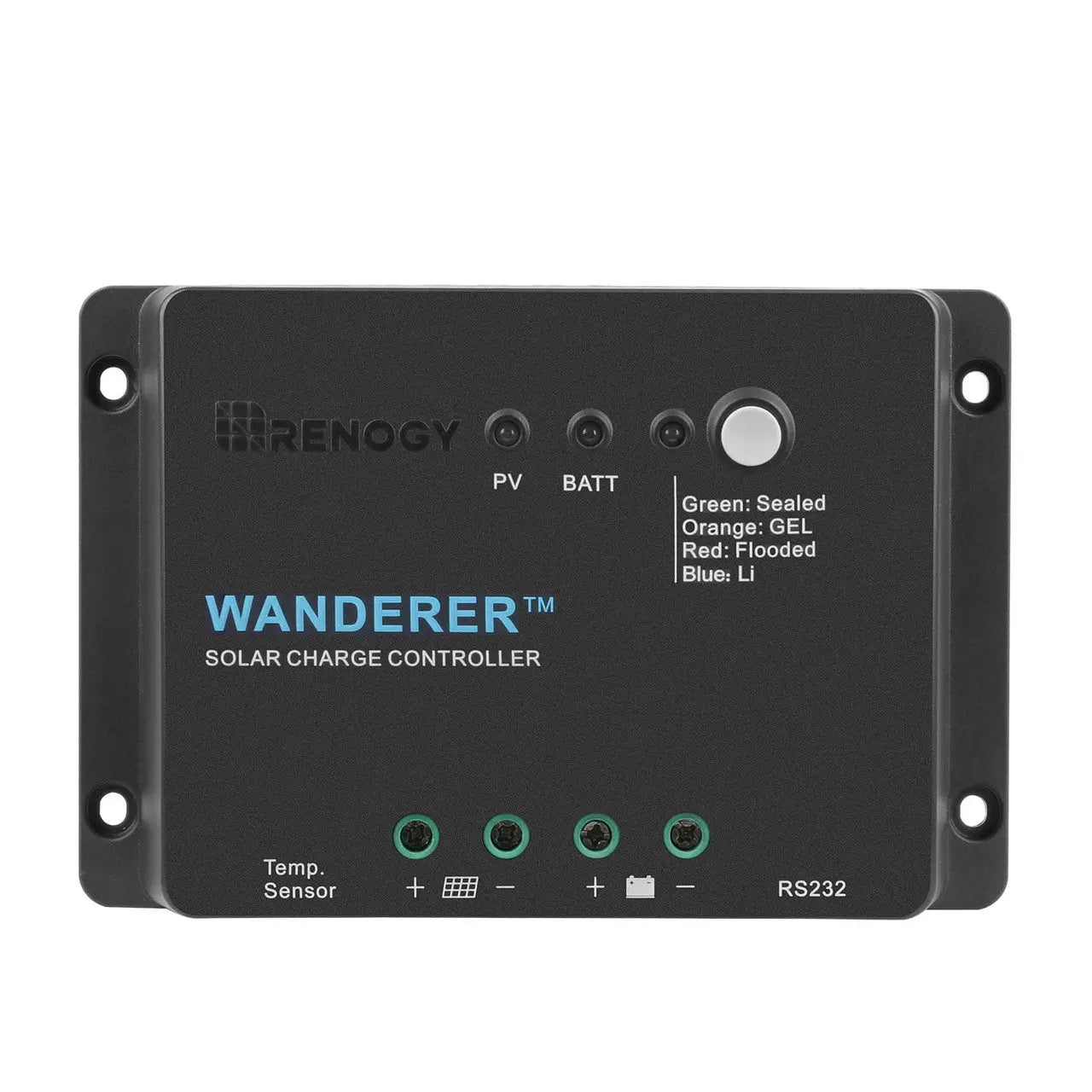
6) Renogy Wanderer Li 30A PWM Charge Controller
Buy on Renogy →
This one needs a warning label. The source data marks it as “mppt,” but the product name is Wanderer Li 30A PWM Charge Controller. I would trust the manufacturer naming over the inconsistent type field and treat this as a PWM unit unless the official product page proves otherwise.
At $32.99, it is cheap, and 30A is useful. But for an article targeting the best MPPT solar charge controllers under $200, this is not a top recommendation. I’m including it because shoppers will absolutely see products like this in filter results and need to know why the price looks too good.
| Key spec | Value |
|---|---|
| Type | Listed as MPPT in source data; product name says PWM |
| Max input current | 30A |
| Bluetooth | Yes |
| App support | Not specified by the manufacturer |
| Price | $32.99 |
Pros - Very low price - 30A rating is attractive on paper - Bluetooth is included
Cons - Product classification is inconsistent - Likely PWM, not true MPPT - Not the right pick for higher-voltage panel setups
7) Renogy Adventurer Li- 30A PWM Flush Mount Charge Controller w/ LCD Display

Buy on Renogy →
The Adventurer Li- 30A PWM Flush Mount Charge Controller w/ LCD Display is not an MPPT controller, but it is a reasonable alternative for RV users who want a flush-mount form factor and built-in display at $82.99. If your panel and battery voltages are closely matched, PWM can still be functional.
I would not buy it over a true MPPT Rover if efficiency and flexibility are the priority. I would buy it only if flush mounting and simple RV integration are more important than extracting every watt from the array.
| Key spec | Value |
|---|---|
| Type | PWM |
| Max input current | 30A |
| Bluetooth | Yes |
| App support | Not specified by the manufacturer |
| Price | $82.99 |
Pros - Flush-mount design is useful in RV installs - 30A capacity - Built-in LCD display
Cons - PWM, not MPPT - Less efficient use of higher-voltage panels - Battery chemistry support not specified by the manufacturer
A few related listings are worth mentioning so you do not confuse accessories with controllers. The Wanderer 10A PWM Charge Controller with BT1 and standard Wanderer 10A PWM model are both PWM, not MPPT. The Battery to Charge Controller Tray Cables for 3/8 in Lugs are just cables, not a controller. If you want to compare wiring needs before ordering, our wire size calculator is the better next click.
What you give up at this price
Under $200, you are mostly buying entry-level to lower-midrange control hardware. The good news is that real MPPT is available. The bad news is that the listings often omit the exact numbers that matter most for system design: maximum PV input voltage, supported chemistries, and richer software features. In this dataset, app support is never clearly specified, even where Bluetooth is listed. That means you should not assume polished remote monitoring just because a Bluetooth flag appears.
You also give up confidence in product categorization. The biggest example here is the Wanderer Li 30A entry, which is marked as MPPT in the source data but named as PWM by the manufacturer. That kind of mismatch is common in marketplace shopping and is exactly how buyers end up with the wrong controller. Cross-check the product page and, if available, the manufacturer datasheet before purchase.
Finally, low upfront price often means tighter current limits. A 10A MPPT controller can be a perfectly good fit for a small 36V or 48V system, but it is not much room for expansion. If your array may grow, buy current headroom now. That is why the Rover Li family stands out here: even with incomplete published specs, the 20A, 30A, and especially 40A variants look more future-proof than the ultra-cheap alternatives.
Frequently asked questions
Is an MPPT controller under $200 actually worth it?+
Yes, if you are pairing it with a modest 12V, 24V, 36V, or 48V solar setup and you want better panel harvesting than a basic PWM unit. At this price, the main compromise is usually lower current, fewer advanced settings, and thinner documentation.
What size MPPT charge controller do I need?+
Start with your array current and battery voltage, then leave headroom for cold-weather output and future panel changes. Use our charge controller calculator to size it correctly instead of buying by price alone.
Are refurbished charge controllers safe to buy?+
They can be, if they come from the manufacturer and the pricing discount is meaningful. The tradeoff is that stock can disappear fast and warranty terms may differ from new units.
Can I use a PWM controller instead of MPPT to save money?+
Sometimes, yes, especially on very small 12V systems with closely matched panel and battery voltages. But MPPT usually makes more sense once panel voltage rises, wire runs get longer, or you want better harvest in cold or variable conditions.
Do these low-cost controllers include app control?+
Not from the data in this lineup. Several list Bluetooth support, but app support is not specified by the manufacturer in the provided product data.
Editor at SolarWorld covering portable power, balcony PV and home energy storage. Specifications quoted in this guide are pulled directly from our product database; analysis and recommendations are by Nathan Cole.
Full bio & methodology →Related articles
- Buying guide · 8 min
Best Stackable Home Batteries 2026: Only 7 Worth Buying
Our 2026 shortlist of modular home batteries, ranked by usable kWh, power, and price—so you can buy the right stack first.
- Buying guide · 8 min
Best Balcony Solar Kits for Renters 2026: 7 Worth Buying
Our 2026 shortlist of renter-friendly plug-and-play balcony solar kits, with honest tradeoffs, prices, and the few setups actually worth your click.
- Buying guide · 8 min
Best 400W+ Solar Panels 2026: Only 7 Worth Buying
Our top 400W+ solar panel picks for 2026, ranked by watts, efficiency, warranty, and value—so you can buy the right high-output module fast.