Best Pure Sine Wave Inverters Under $500 (2026)
If your budget stops at $500, the best buys are not evenly spread. The real sweet spot is around $300 to $465, where you can still get 2000W to 3500W of continuous output if you accept either a basic off-grid inverter or a refurbished inverter-charger. Based on the current data, my top pick is the PUH 12V 3000W/2000W/1000W Pure Sine Wave Inverter with UPS Transfer Switch and Built-in Bluetooth at $461.99 because it combines 3000W output with a UPS transfer switch and Bluetooth without breaking the cap.
Quick picks
| Category | Model | Why it stands out | Price |
|---|---|---|---|
| Best overall | Renogy PUH 12V 3000W Pure Sine Wave Inverter with UPS Transfer Switch and Bluetooth | 3000W continuous plus UPS transfer switch and Bluetooth at $461.99 | $461.99 |
| Best value | Renogy Refurbished 3000W 12V Pure Sine Wave Inverter | 3000W continuous for $299.99 is the strongest watts-per-dollar deal here | $299.99 |
| Best for 48V battery banks | Renogy Refurbished 48V 3500W Solar Inverter Charger | 3500W continuous and 48V input for larger off-grid systems at $399.99 | $399.99 |
How we picked
We filtered the current full database for pure sine wave inverter and inverter-charger products priced below $500, then ranked them by usable continuous output, system voltage, feature set, and value per dollar. We also favor models that solve a specific use case cleanly rather than padding the spec sheet with vague claims; you can see our scoring methodology on the editorial side, and our affiliate disclosure explains how links are monetized.
What “good” looks like at this price
Under $500, “good” usually means one of three things: a basic 1000W to 2000W inverter bought new, a 3000W class inverter bought refurbished, or a feature-rich 12V inverter that uses most of your budget. You should not expect complete published specs at this price. In this dataset, peak surge wattage, efficiency, MPPT count, and warranty length are often not specified by the manufacturer, so buying on headline wattage alone is risky.
The biggest technical tradeoff is battery-side current. A 3000W inverter on 12V can demand roughly 250A before losses, while a 2000W inverter on 24V needs about half that current for the same power level. That is why 24V and 48V systems get easier to wire as power climbs. If you need help matching inverter size to battery voltage and loads, size your system first, then cross-check cable and battery requirements with a tool like our solar battery calculator. For reference on system losses and performance modeling, NREL’s PV research library remains one of the better public sources (NREL).
A good unit in this bracket should also be honest about its role. None of the products here are grid-tied. Some are straight off-grid inverters, while some are inverter-chargers or UPS-style units with transfer switching. If you need battery charging, shore power pass-through, or a cleaner backup-power workflow, pay close attention to which models are charger-equipped and which are not.
Which inverter type makes the most sense under $500?
For most buyers, there are two sensible paths. First: buy a simple pure sine wave inverter if you already have a charger, transfer switch, and battery system sorted out. Second: buy an inverter-charger or UPS-style unit if you want fewer boxes and easier backup integration.
The cheaper path is almost always the plain inverter. That is why the Refurbished 3000W 12V Pure Sine Wave Inverter stands out so strongly at $299.99. But if you want automatic transfer behavior or charging capability, the premium for a combo unit can be worth it. The Refurbished 48V 3500W Solar Inverter Charger and Refurbished 3000W 12V Pure Sine Wave Inverter Charger w/ LCD Display are the clearest examples in this list.
Is refurbished the smart play in this price range?
Usually, yes. In this lineup, refurbished units are the only reason 3000W to 3500W products fit comfortably under $500. If you insist on new-only hardware, your practical ceiling drops fast unless you accept fewer features or lower output.
The tradeoff is uncertainty. Warranty years are not specified in the source data for any product here, so I cannot tell you that the refurb coverage matches the new models. That matters. A refurb inverter can still be the right buy, but only if the discount is large enough to justify the missing certainty. At $299.99 for 3000W, the math is compelling; at $499.99 for a refurb inverter-charger, you need to value the charger and LCD enough to accept the narrower savings margin.
The 7 best models
1) Renogy PUH 12V 3000W/2000W/1000W Pure Sine Wave Inverter with UPS Transfer Switch and Built-in Bluetooth

Price: $461.99
Continuous output: 3000W
Type: off-grid
Off-grid capable: false in source data
Grid-tied: no
This is the strongest all-around pick because it gives you 3000W continuous output plus two features that usually cost extra: UPS transfer switching and built-in Bluetooth. If you want one box for backup-style operation on a 12V battery system, this is the most complete new unit under the cap. See the product page for the PUH 12V 3000W/2000W/1000W Pure Sine Wave Inverter with UPS Transfer Switch and Built-in Bluetooth.
Pros
| 3000W continuous output under $500 |
| Includes UPS transfer switch |
| Built-in Bluetooth adds easier monitoring |
Cons
| 12V at 3000W means very high battery current |
| Peak surge wattage not specified by the manufacturer |
| Source data lists off-grid capable as false, which is unclear for this product class |
2) Renogy Refurbished 48V 3500W Solar Inverter Charger
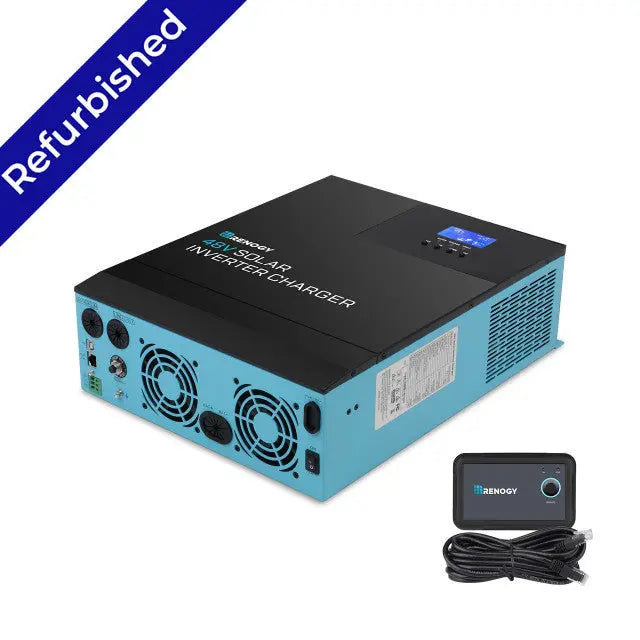
Price: $399.99
Continuous output: 3500W
Type: hybrid
Off-grid capable: true
Grid-tied: no
This is the highest-output model in the dataset at 3500W continuous, and it does it on 48V, which is exactly what you want once loads move beyond the small-cabin tier. For larger battery banks, lower current on the DC side is a real advantage. The Refurbished 48V 3500W Solar Inverter Charger is the best niche pick here for 48V systems.
Pros
| Highest continuous output in this list at 3500W |
| 48V input is better suited to larger loads |
| Inverter-charger format simplifies system design |
Cons
| Refurbished unit, not new |
| Efficiency and MPPT details not specified by the manufacturer |
| Likely overkill for small 12V van or RV systems |
3) Renogy 2000W 24V Pure Sine Wave Inverter

Price: $339.99
Continuous output: 2000W
Type: off-grid
Off-grid capable: false in source data
Grid-tied: no
If you want a new, straightforward inverter and already run a 24V battery bank, this is one of the cleanest buys here. The 2000W 24V Pure Sine Wave Inverter avoids the brutal current draw of a 12V 2000W setup and lands at a reasonable $339.99.
Pros
| 24V input keeps DC current more manageable |
| 2000W is enough for many small off-grid loads |
| New unit at a sensible midrange price |
Cons
| No charger or UPS transfer features listed |
| Peak surge wattage not specified by the manufacturer |
| Less compelling if your battery bank is already 12V |
4) Renogy Refurbished 3000W 12V Pure Sine Wave Inverter

Price: $299.99
Continuous output: 3000W
Type: off-grid
Off-grid capable: true
Grid-tied: no
Pure value. At $299.99, the Refurbished 3000W 12V Pure Sine Wave Inverter delivers more output per dollar than anything else on this page. If you already have charging and transfer hardware, this is the budget power play.
Pros
| 3000W continuous for just $299.99 |
| Strong value for cabins, trailers, and backup projects |
| Off-grid capable in source data |
Cons
| Refurbished condition may deter some buyers |
| 12V at 3000W demands heavy cabling and a serious battery bank |
| No charger, LCD, or Bluetooth features listed |
5) Renogy Refurbished 1000W 12V Pure Sine Wave Inverter with Power Saving Mode (New Edition)

Price: $179.99
Continuous output: 1000W
Type: off-grid
Off-grid capable: true
Grid-tied: no
This is the right kind of small inverter for light-duty jobs: laptop charging, routers, TVs, small kitchen loads, and basic backup circuits that stay well below 1000W continuous. The Refurbished 1000W 12V Pure Sine Wave Inverter with Power Saving Mode (New Edition) is one of the cheapest legitimate entry points in the list.
Pros
| Low entry price at $179.99 |
| Power saving mode is useful for light intermittent loads |
| Good fit for small 12V systems |
Cons
| 1000W ceiling rules out many appliances |
| Refurbished rather than new |
| Surge rating not specified by the manufacturer |
6) Renogy Refurbished 3000W 12V Pure Sine Wave Inverter Charger w/ LCD Display

Price: $499.99
Continuous output: 3000W
Type: hybrid
Off-grid capable: true
Grid-tied: no
This one barely makes the cutoff, but it earns its place because it combines 3000W output with charger functionality and an LCD. If you want an all-in-one style backup component and can spend the full budget, the Refurbished 3000W 12V Pure Sine Wave Inverter Charger w/ LCD Display is one of the few ways to get there under $500.
Pros
| 3000W continuous plus charging capability |
| LCD display is better than guessing system status |
| Hybrid format reduces separate component count |
Cons
| Most expensive model here at $499.99 |
| Refurbished unit at nearly new-product money |
| 12V architecture still means high DC current |
7) Renogy 700W 12V Pure Sine Wave Inverter

Price: $149.99
Continuous output: 700W
Type: hybrid
Off-grid capable: true
Grid-tied: no
The 700W 12V Pure Sine Wave Inverter is the cheapest model I’d consider for genuinely small loads. It is not a kitchen-appliance inverter and not a space-heater inverter. It is for chargers, entertainment gear, networking gear, and other modest electronics.
Pros
| Lowest price in the list at $149.99 |
| Small enough for light-duty 12V systems |
| Pure sine wave output suits sensitive electronics |
Cons
| 700W is very limiting in real-world use |
| Type is listed as hybrid, but feature details are sparse |
| Not enough headroom for many startup surges |
What you give up at this price
The first thing you give up is documentation depth. Across this dataset, many crucial fields are missing: peak surge wattage, efficiency, warranty length, and MPPT count are often not specified by the manufacturer. That does not make the products bad, but it does mean you are buying with less certainty than you would in a higher tier. If you need tightly documented performance, this price band is thin.
The second thing you give up is electrical elegance. Most of the high-output bargains here are 12V units, and 12V gets awkward fast above 2000W. Heavy current means thicker cabling, stricter fuse selection, and less room for sloppy installs. The 24V and 48V options are better engineering fits for bigger loads, but there are fewer of them in this budget. Before you buy, check your battery bank, cabling, and expected appliance startup loads with size your system and a second-pass load estimate using our off-grid load calculator.
The third thing you give up is peace of mind on condition and support. Several of the best deals are refurbished, and that is exactly why they are on this page. If your goal is maximum watts per dollar, refurb is hard to beat. If your goal is longest support horizon, newest hardware, and the fullest published spec sheet, you will likely need to spend more than $500.
Frequently asked questions
What size pure sine wave inverter should I buy?+
Start with the continuous wattage of the appliances you want to run at the same time, then leave headroom for startup surges. Our rule of thumb is to buy at least 20% above your real load, and use a sizing tool before you order.
Is a refurbished inverter worth buying under $500?+
Often yes, if the seller is reputable and the discount is large enough to justify the risk. In this price band, refurbished units are one of the few ways to get 3000W to 3500W output without crossing $500.
Can I run sensitive electronics on these inverters?+
Pure sine wave output is the right choice for laptops, chargers, TVs, and many motor-driven appliances. That said, you still need enough continuous wattage and a battery bank that can support the inverter at full load.
Is 12V or 24V better for an inverter under $500?+
For smaller systems, 12V is simpler and has more accessory compatibility. For around 2000W and up, 24V usually makes more electrical sense because current is lower, which can reduce cable size, voltage drop, and stress on the battery side.
Are these grid-tie inverters?+
No. Every model in this list is marked non-grid-tied in the source data. These are off-grid or inverter-charger style products, not utility-interactive grid-export inverters.
Editor at SolarWorld covering portable power, balcony PV and home energy storage. Specifications quoted in this guide are pulled directly from our product database; analysis and recommendations are by Nathan Cole.
Full bio & methodology →Related articles
- Buying guide · 8 min
Best Stackable Home Batteries 2026: Only 7 Worth Buying
Our 2026 shortlist of modular home batteries, ranked by usable kWh, power, and price—so you can buy the right stack first.
- Buying guide · 8 min
Best Balcony Solar Kits for Renters 2026: 7 Worth Buying
Our 2026 shortlist of renter-friendly plug-and-play balcony solar kits, with honest tradeoffs, prices, and the few setups actually worth your click.
- Buying guide · 8 min
Best 400W+ Solar Panels 2026: Only 7 Worth Buying
Our top 400W+ solar panel picks for 2026, ranked by watts, efficiency, warranty, and value—so you can buy the right high-output module fast.